Home/Literary Panorama/The Path of Learning: Days of Studying, Testing, and Camaraderie/
Back
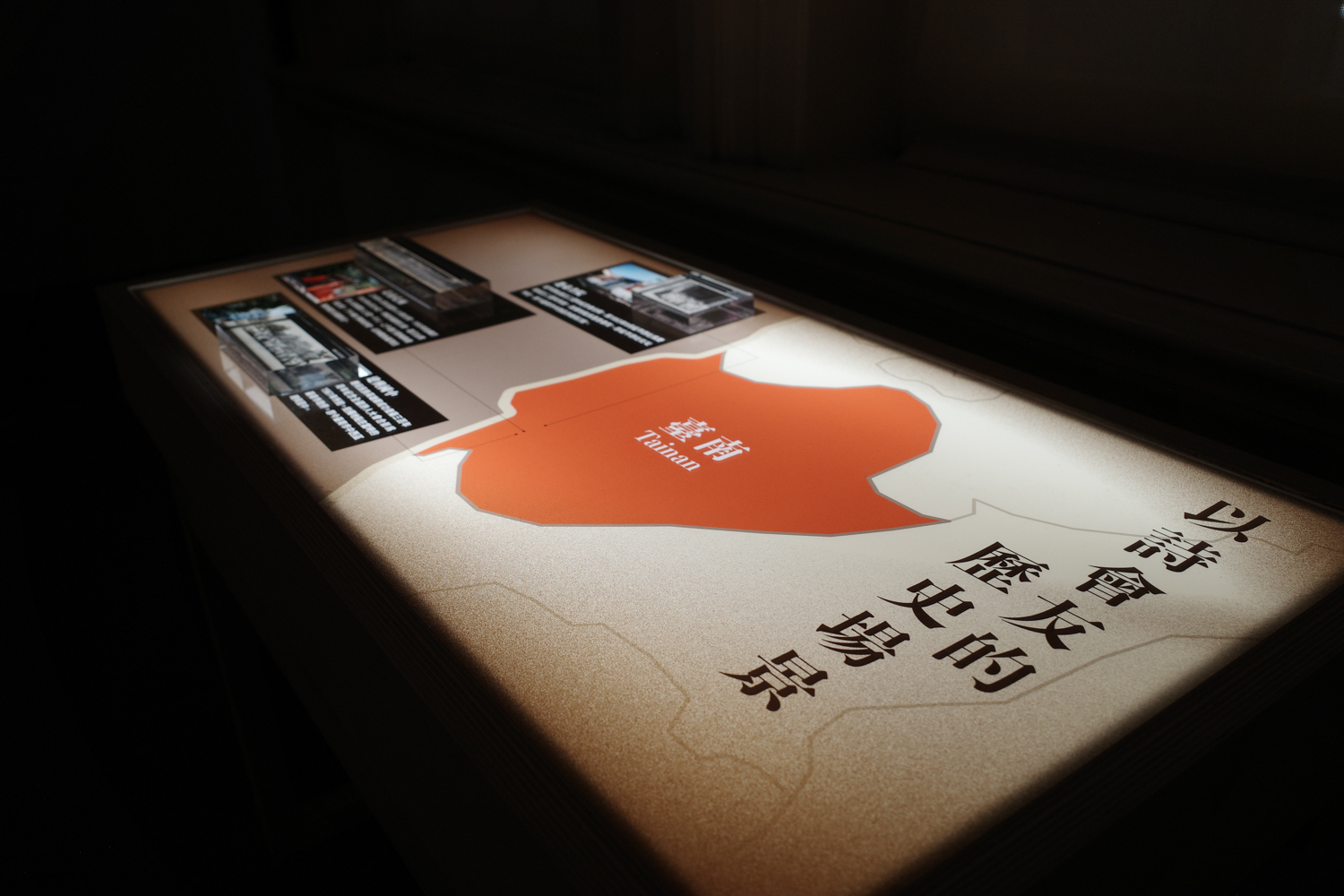
Your Friends List, Followers, and Subscriptions: The Social Media Platforms of a Century Past

Your Friends List, Followers, and Subscriptions
The Social Media Platforms of a Century Past
Gatherings of poetry societies were a driving force behind the growth and development of the classical poetry community in Taiwan. Scholars had been gathering in the name of poetry and literature since shi zhong (timed poetry composition) competitions were introduced to Taiwan during the Qing dynasty. Gradually, they established institutionalized social groups which held regular meetings. Artifacts such as their society regulations, their commemorative bells, and their publications give us a record of the way they operated and their cultural backdrop from the Qing era, through Japanese colonial times, all the way to the postwar period, and testify to the irrepressible liveliness of classical poetry culture within Taiwan's literary circles.
The poetry composition games held at poetry gatherings combined elegance, competition, and social interaction. Poets had to complete a poem on a set topic within a time limit, using only certain rhymes. They would then judge and rank each other's poems, giving them titles harking back to classical Chinese scholar rankings—zhuangyuan, bangyan, tanhua—carrying on the spirit of the imperial exams. Besides poetry exchanges, society gatherings often served as opportunities for birthday celebrations, commemorations, and activities to encourage one another. Thanks to materials such as group photos, prizes, and certificates, we have a rich cultural record of these activities. From the Japanese colonial era onward, female poets also participated actively in poetry gatherings, contributing their diverse creative styles and social engagement. In this way, poetry societies functioned almost as the social media platforms of Taiwan a century ago, bringing together like-minded thinkers and writers to make connections and friends across bridges of literature and poetry.
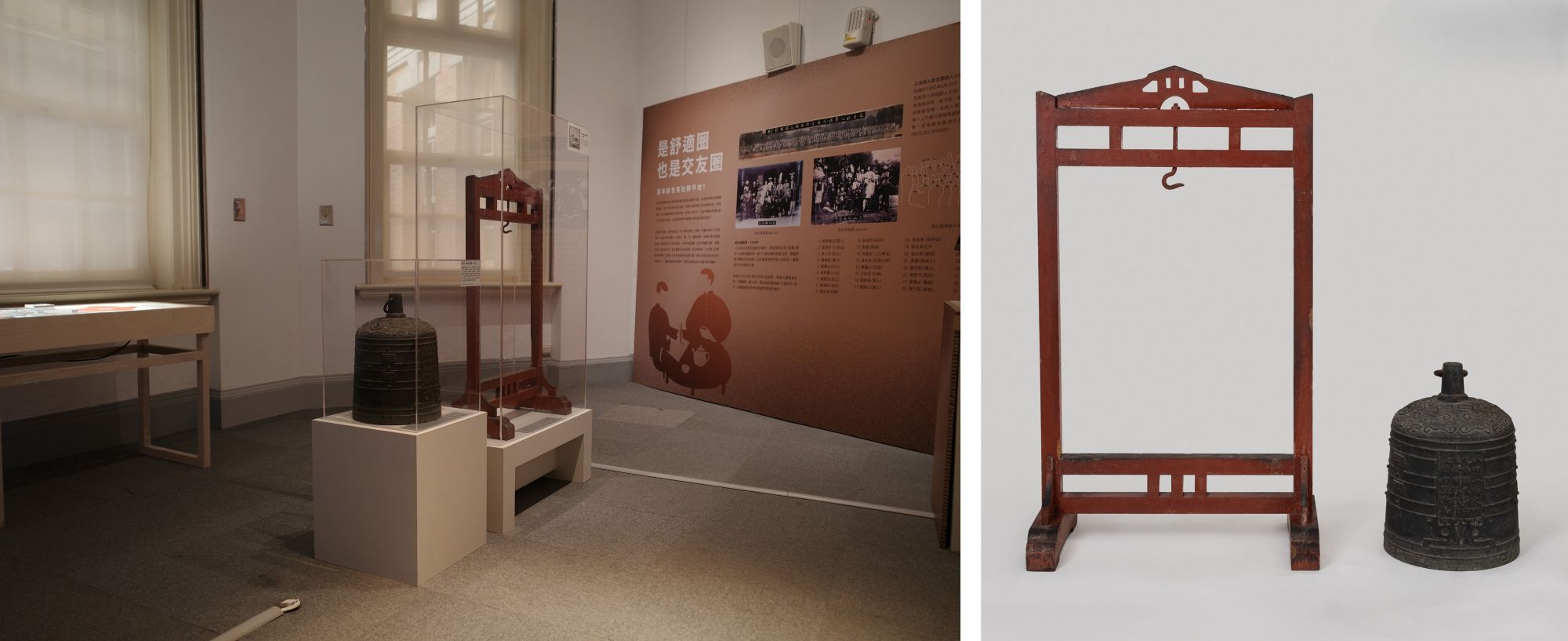
|Commemorative Bell for the 30th Anniversary of the Oak Poetry Society, 1931|
This bell was cast in 1931 to commemorate the 30th anniversary of the founding of the Oak Poetry Society. Upon the bell is an inscription invoking the power of poetry and the continuation of literary tradition: "Strike lightly and it will sound lightly; strike strongly and it will sound strongly. May we scholars sing our verse in harmony to enlighten the ignorant, never letting our sound fade." The inaugural striking ceremony held at Dongshan Villa in Taichung, and performed by 16-year-old Wu Yan-sheng, symbolically ringing in the new generation of poets. Three bells were originally cast; two survive today. The bell stands as an important symbol of poetry society culture and a testament to its flourishing under Japanese colonial rule.
NMTL20220130001 / Donated by Wu Bei-he and Wu Nan-jun.
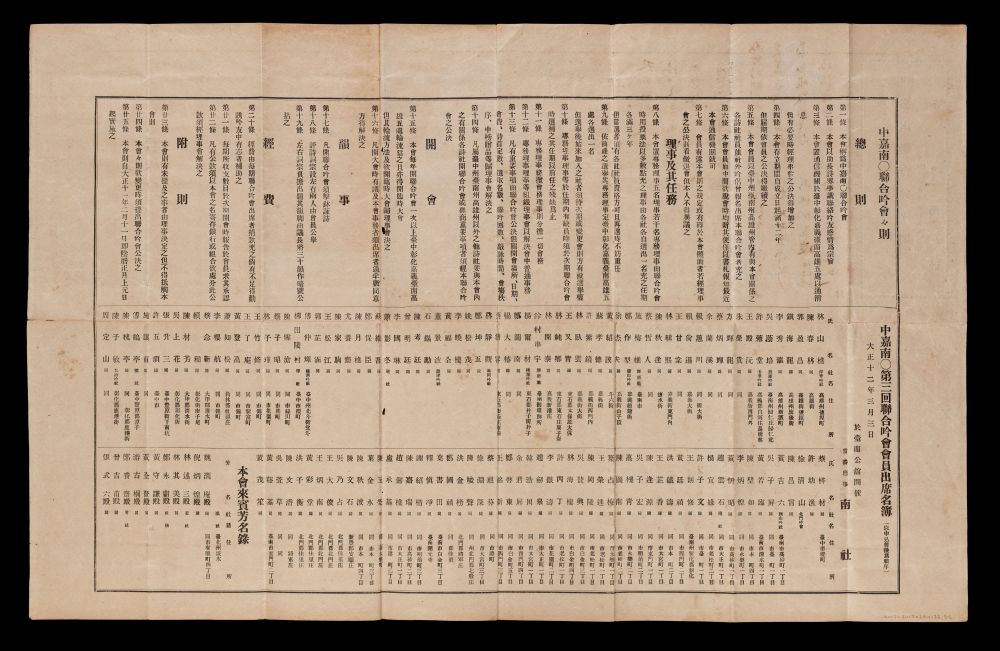
|Chung-Chia-Nan Joint Poetry Convention Handbook, 1923|
This copy of the handbook for the Chung-Chia-Nan (Taichung, Chiayi, Tainan) Joint Poetry Convention, organized by the Nan Poetry Society. It includes the 25 regulations governing the convention and a roster of society members and guests attending the third Convention. The Taichung-Chiayi-Tainan Joint Poetry Convention was convened by poetry societies from the Taichung, Chiayi, Tainan, and Kaohsiung areas in the south of Taiwan, who took turns hosting it.
The 1923 Convention was held on March 3 in Tainan's Public Hall (now the Wu Garden). The Nan Poetry Society organized several planning groups before the event, in which fifteen poetry societies were represented, with this handbook listing in detail the names of all attendees, the poetry societies they belonged to, and where they lived. This document shows us how large-scale poetry gatherings were organized during the Japanese colonial era, and is valuable reference material concerning the classical poetry community of the 1920s.
NMTL20170240136 / Donated by the family of Wu Te-kung
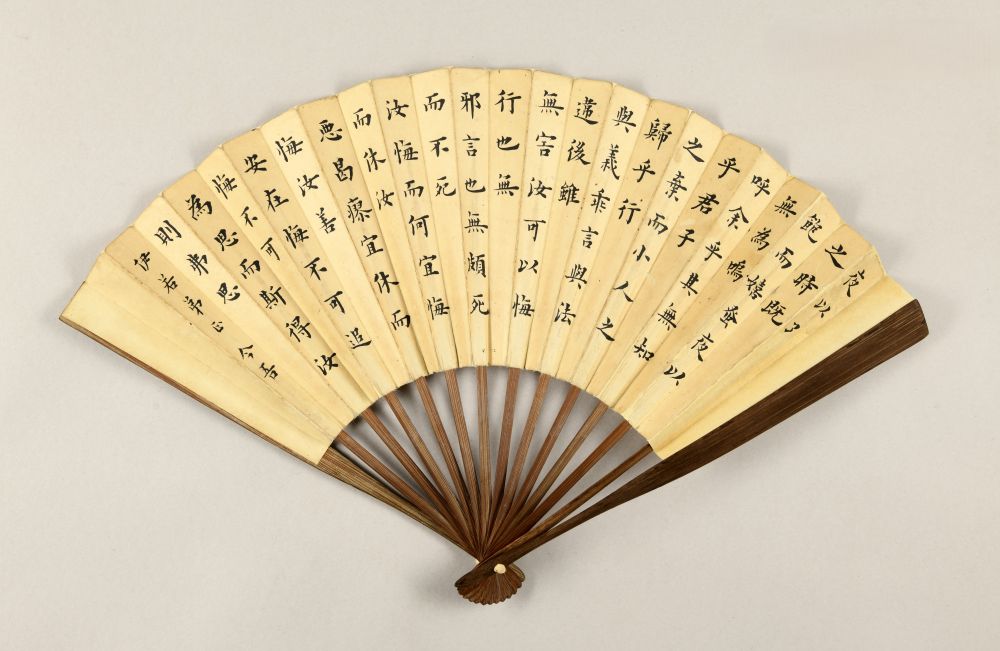
|Folding fan, given by Lin Chao-song to Chuang Sung, 1913|
On one side of this fan is inscribed Han Yu's Five Admonitions, as well as "To my younger brother Yi Ruo - from Jin Wu." On the other side is written an excerpt from the Records of the Grand Historian (“Biography of Qu Yuan and Jia Yi”), dated "Summer of Gui Chou" (1913). The calligrapher of this side is unknown.
Lin Chao-song (pen names Chi Hsian and Jin Wu) and Chuang Sung (Yi Ruo) were both members of the Oak Poetry Society. The inscriptions on the fan reflect their ideals of moral integrity and self-cultivation, illustrating the deep friendship and refined literary correspondence between them.
NMTL20230350001 / Donated by Chuang Yung-sui
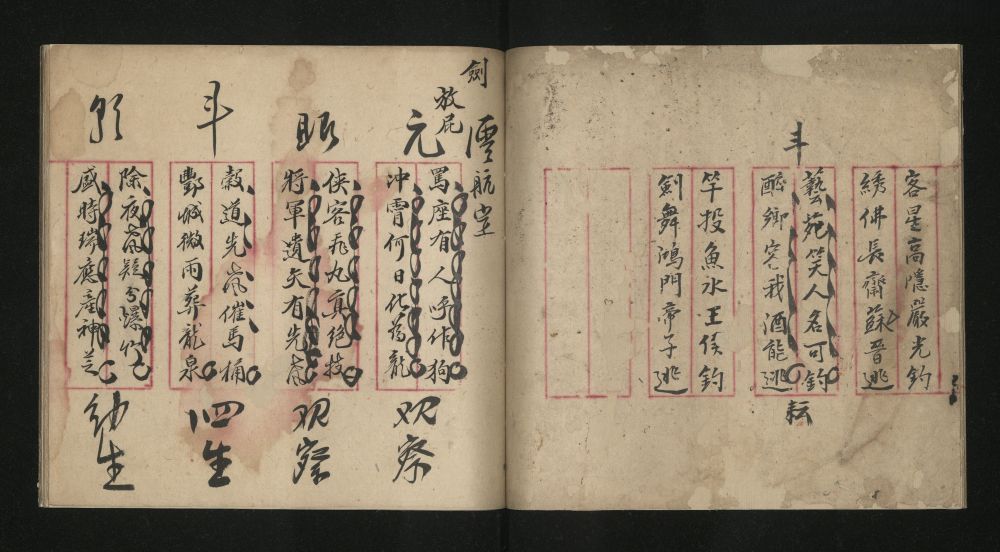
|Copies of Poems from Phoenix Pavilion Shi Zhong Game, Guangxu era (1875-1908)|
This is a manuscript of a shi zhong poetry composition contest, with the format being "separate verse," in which the first and second lines of each couplet describe two different things. In this format, topics can be elegant or vulgar or a mix, but the topics themselves may never be directly mentioned. In this case, the two topics were "sword" and "fart."
During the Guangxu era, Taiwanese Daoist T'ang Ching-sung invited Shih Shih-chi, Ch'iu Feng-chia, Wang Chun-yuan, Lin Chi-dong, Huang Ts'ong-ding, and others to the Phoenix Pavilion in Tainan to attend poetry contests. Yün Fang (Shih Shih-chi) served as the master lyricist, judging the poems and awarding them titles of yuan, yan, hua, lu, dou, hui, chao, and lü. The ranks of yuan and yan were both taken by Guan Cha (T'ang Ching-sung).
NMTL20170290027 / Donated by the family of Huang Tien-Ch'üan
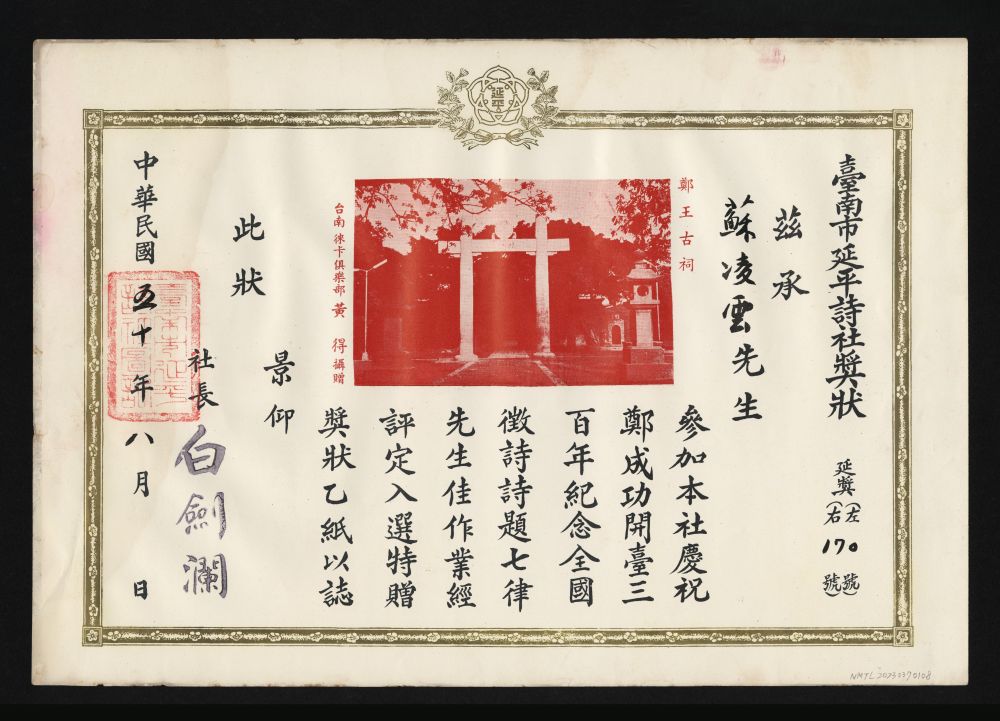
|Certificate of Selection for "300-year Anniversary Memorial to Koxinga's Opening of Taiwan," awarded to Su Ling-yun, 1961|
This certificate was issued by Tainan's Yanping Poetry Society to Su Ling-yun (Su Luan) for her poem submitted to a poetry contest. The seven-character poem describing Koxinga's resistance against the Qing dynasty and his establishment of a base for that purpose in Taiwan reads:
"At the temple he burned garments, swearing to resist the Qing; he received imperial favor, and was entrusted with an expedition.
With tides rising at Lu'er, warships set sail; territory was expanded at Kunshen, with troops stationed in full armor.
With a steadfast loyal heart he served the Yongli court; heaven preserved this distant isle to remember Yanping.
Three hundred years have passed, and his shrine is now ancient; his deeds endure forever at the Chikan Tower.”
The certificate features a printed photograph of the Koxinga Shrine, reflecting how postwar poetry societies incorporated local cultural imagery into the design of materials for poetry competitions.
NMTL20230370108 / Donated by Tang Bai-keng
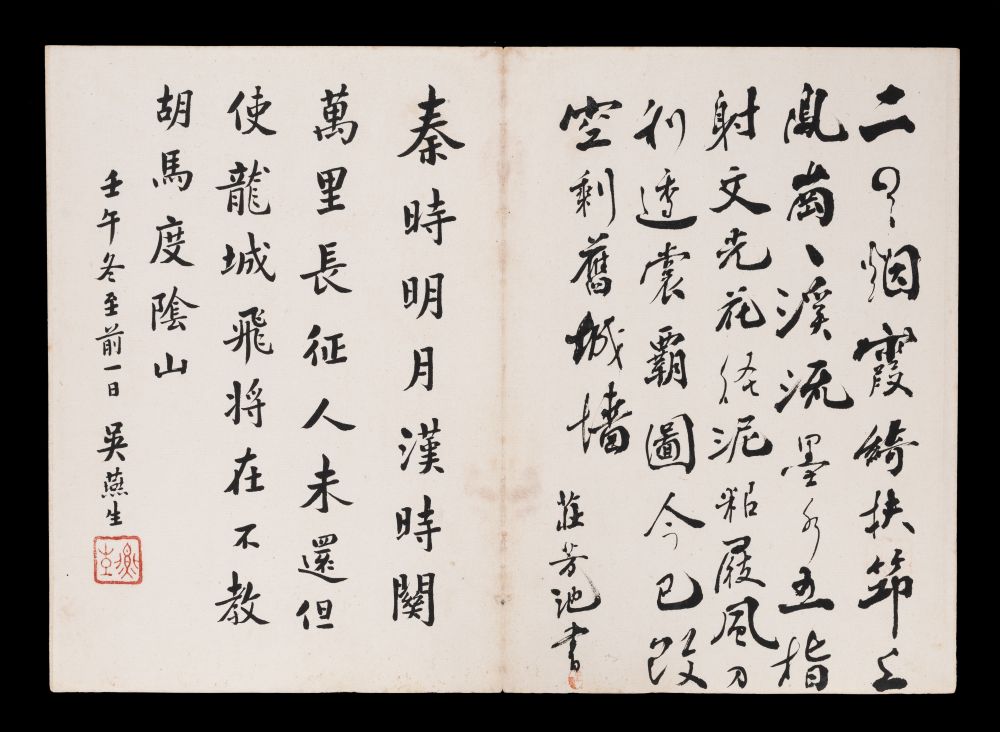
|Poem by Wang Changling, inscribed in regular script by Wu Yan-sheng, 1942.|
This is an inscription of Tang dynasty poet Wang Changling's "Beyond the Frontier."
"Under the shining moon from the Qin and the Wall of the Han, men do not return from remote campaigns.
Were the Flying General at the Dragon City, never would a Hu horseman cross the Yin Mountains!"
Her brush technique is upright and orthodox, and the flow is clear and lively, showing his strong background in the classic arts. Wu Yan-sheng was the granddaughter of Wu Luan-chi and the daughter of Oak Poetry Society member poet Wu Tzu-yü. From an early age, she was surrounded by classical Chinese culture, and was quite active in poetry circles during the Japanese colonial and postwar eras.
NMTL20080050014 / Donated by Chen Yun-cheng
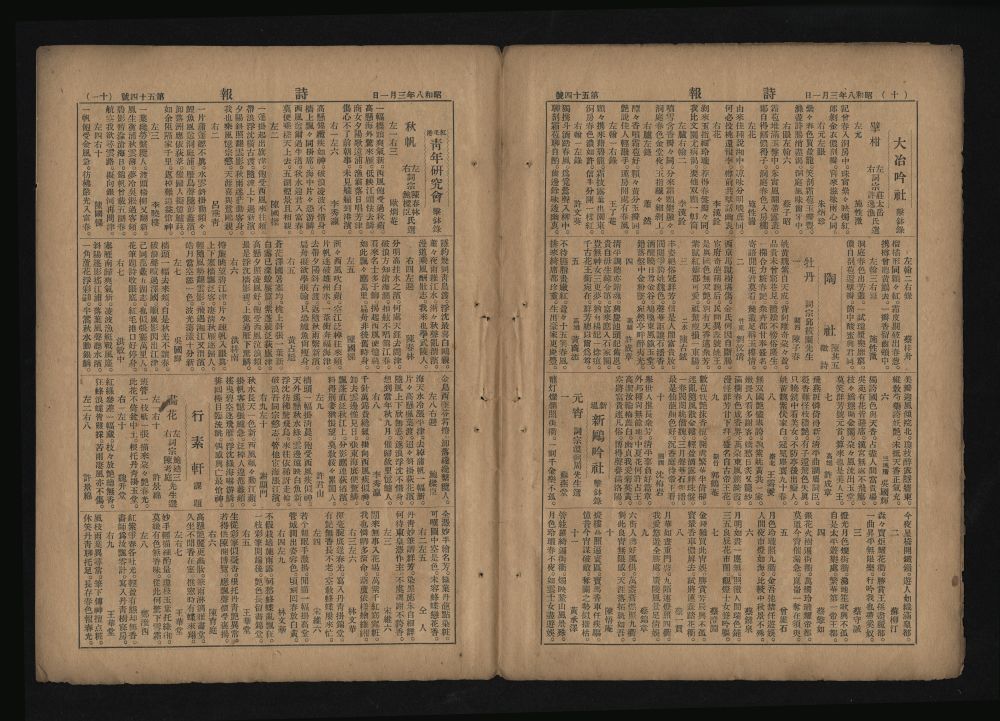
|Poetry, Issue 54, 1930.|
Founded in Shōwa 5 (1930), this bimonthly classical poetry journal published works from poetry societies across Taiwan, and especially those produced through poetry contests and timed ji bo composition games. This page features poems from a ji bo composition game held by the Daye Poetry Society in Lukang, Changhua. The prompt was "splitting a tangerine."
A ji bo poetry composition contest involved an organizer choosing a topic, rhyming scheme, and format for a poem, which poets then had to complete within a time limit. Poems would then be assessed and ranked (and awarded imperial examination titles) by the "left" and "right" master lyricists (judges). Poetry published the fruits of these games, showcasing the liveliness and competitive spirit of the poetry circles of the day.
NMTL20230420016 / Donated by Chen Wei-cheng, Chen Jun-hua, and Chen Jun-ying

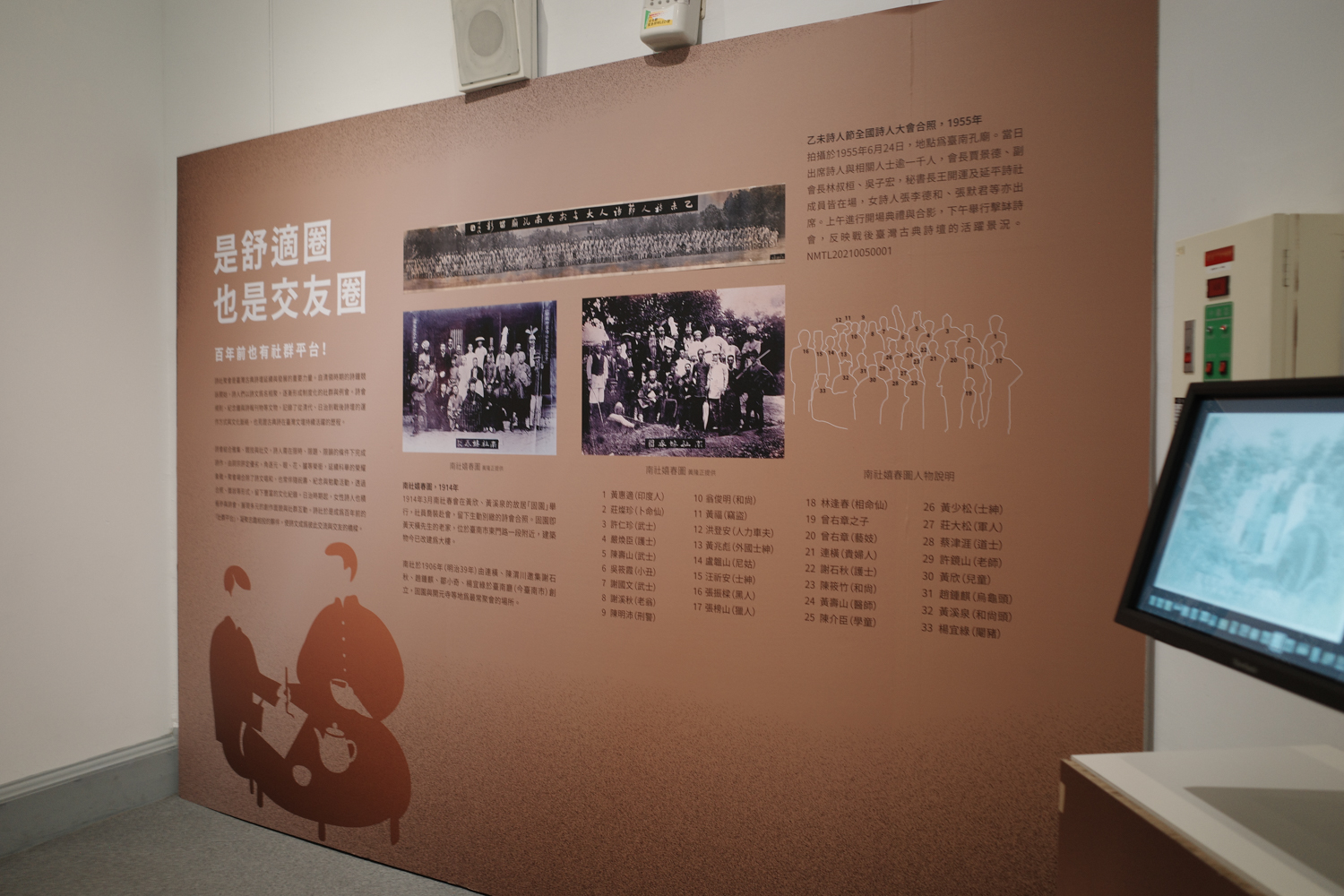
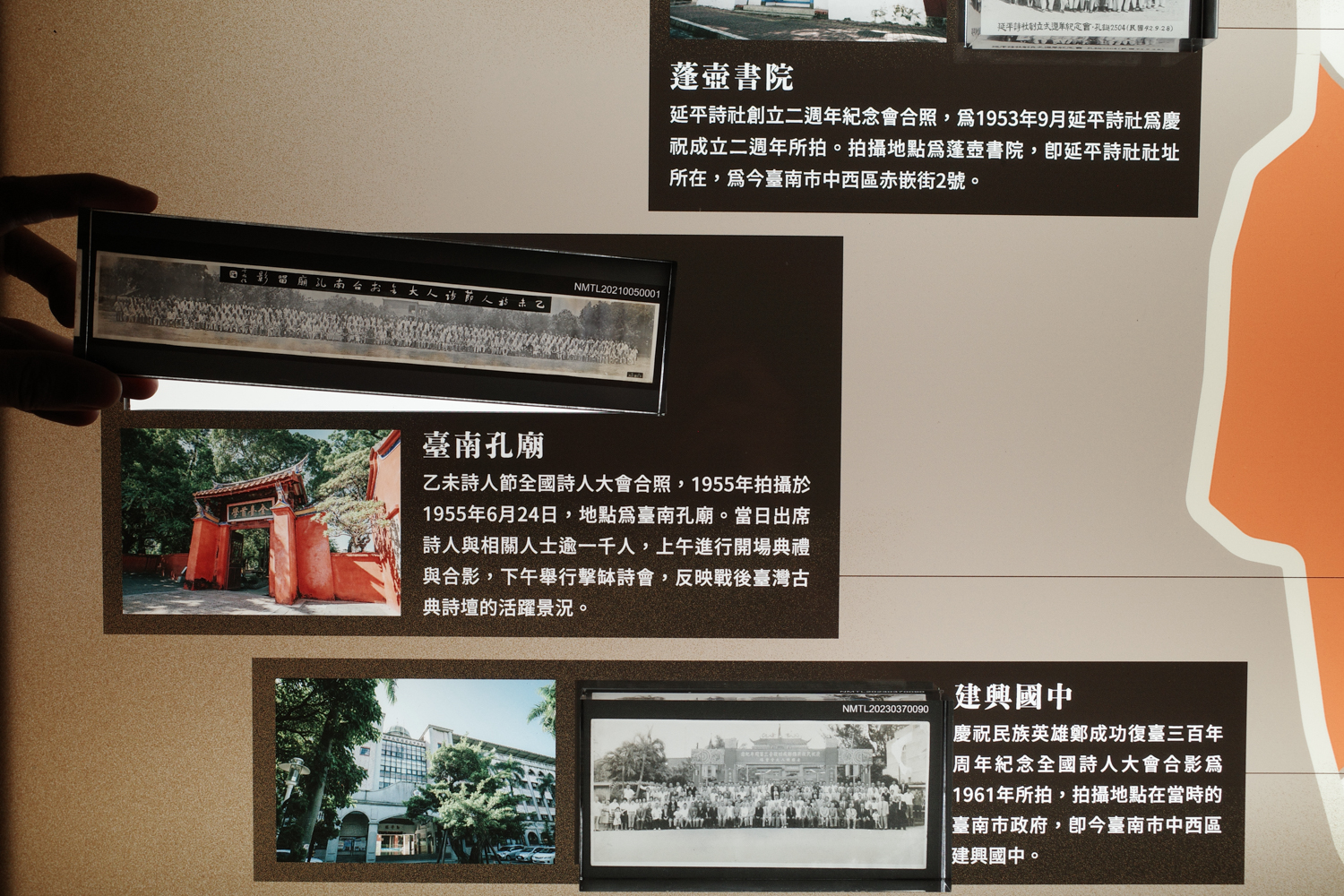
|Group Photo at the 1955 Poet's Day National Poets' Congress|
Taken June 24 1955 at the Tainan Confucian Temple. Over a thousand poets and associated figures attended the Congress, including Chairman Chia Ching-teh, Vice Chairmen Lin Shu-huan and Wu Tzu-hong, Secretary General Wang Kai-yun, and members of the Yanping Poetry Society. Female poets Chang Lee Te-he and Zhang Mojun were also present. The opening ceremony was held in the morning, and group photos were taken. In the afternoon, timed ji bo poetry competitions were organized. The scale of this event shows the vibrancy of the classical poetry community that existed in postwar Taiwan.
NMTL20210050001 / Unknown donor
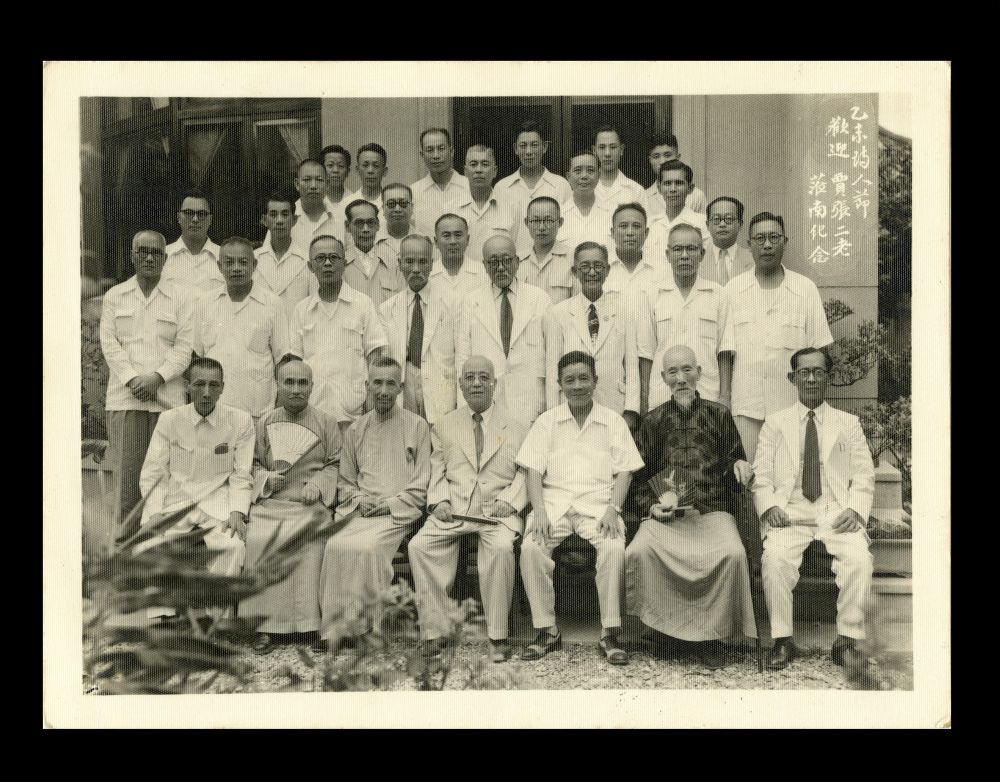
|Welcoming Poets Chia Ching-teh and Chang Chao-ch'in to Tainan for Poet's Day, 1955|
Taken on the evening before the 1955 Poet's Day National Poets' Congress. More than fifty poets from northern Taiwan, including Chia Ching-teh and Chang Chao-ch'in, traveled south in advance and met in Tainan at Lin Shu-huan's residence, the Liyuan. Wu Tzu-hong, Shih Yu-ch'in, Chang Chao-ch'in, Chia Ching-teh, Lin Shu-huan, Huang Pai-ch'ing, and Lin Lan-ya are present in the photo, along with many members of the Yanping Poetry Society, such as Lin Hai-lou, Yeh Chan-mei, Hong Tzu-heng, Huang Ch'i-t'ao, Lin Ts'ao-hsiang, Kao Huai-ch'ing, Yan Hsing, and Yang Nai-hu. This photo, along with the group photo taken the next day, highlights the vibrant exchange going on between northern and southern poets at the time.
NMTL20210120002 / Donated by Yang Chih-hsiung
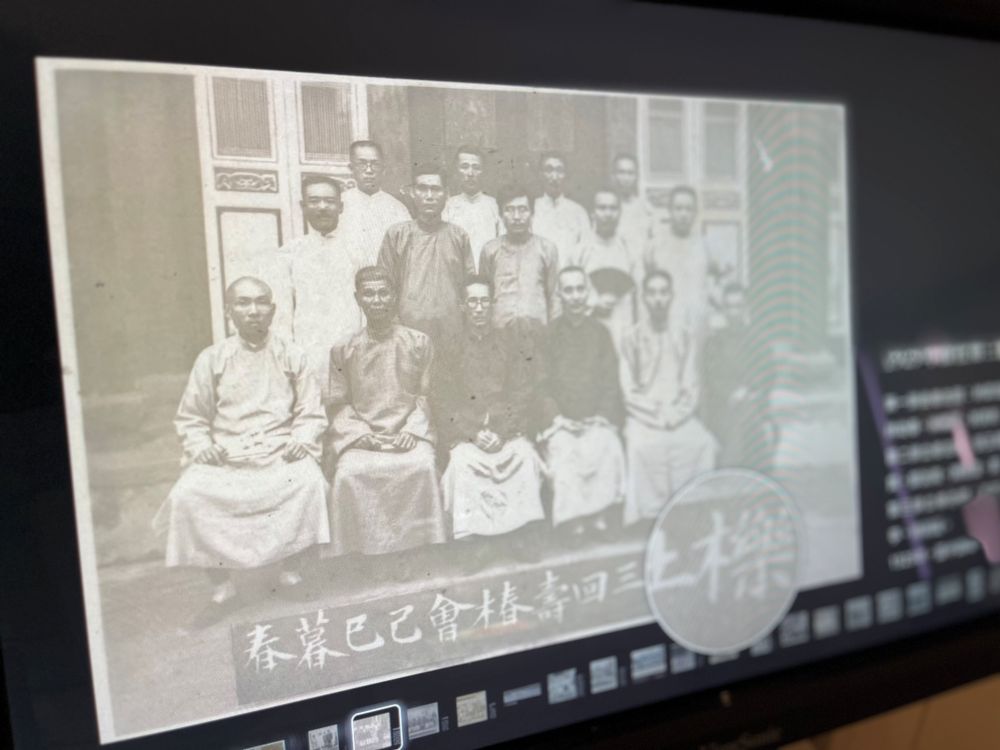
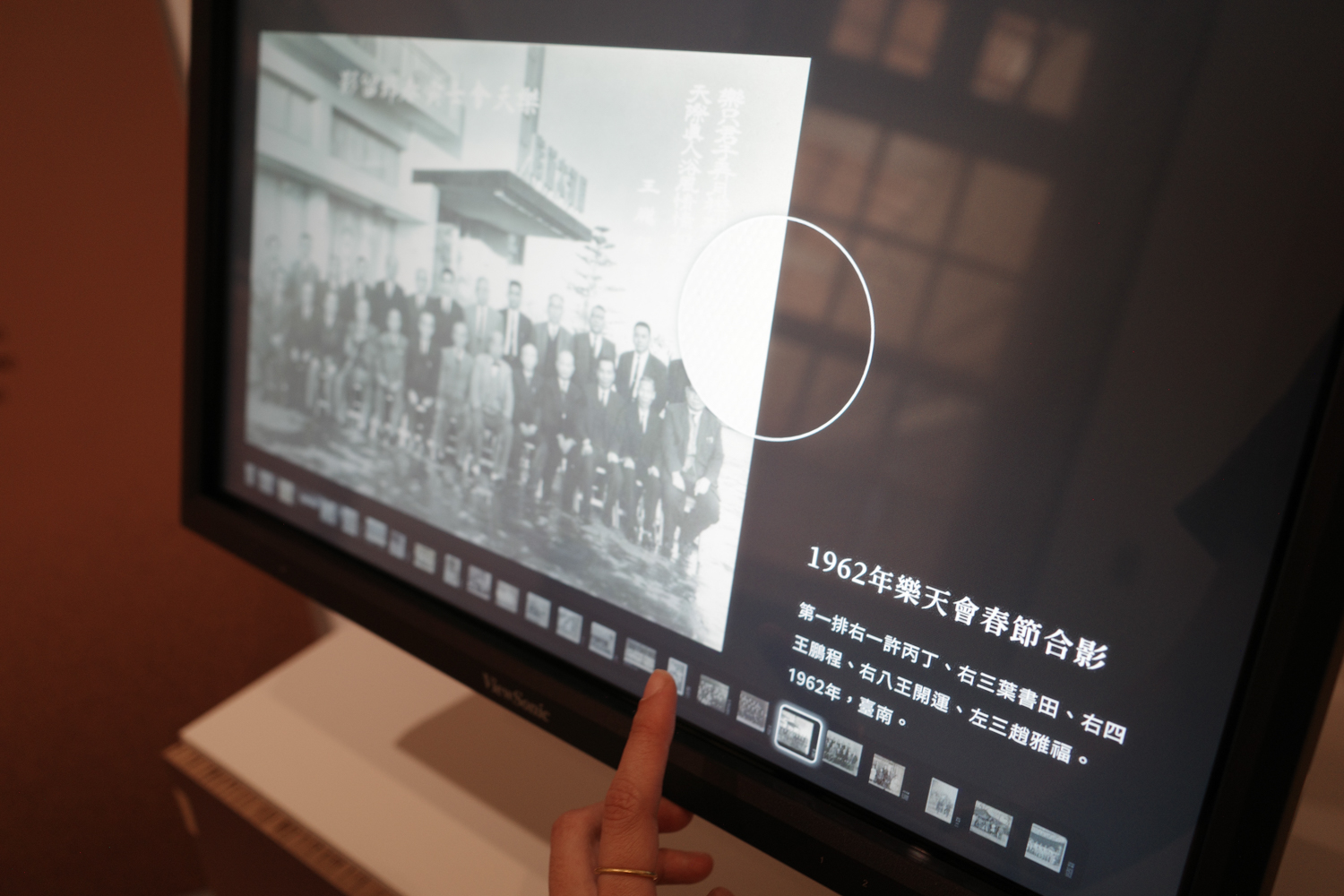
|Group Photo of the Oak Poetry Society's 3rd Shouchun Celebration|
Taken May 4 1929 at the Wufeng Lin Family Mansion's Great Flower Hall, when the 50th birthdays of Lin Yu-chun and Chuang Sung were being celebrated. Attendees included Lin Hsien-tang, Fu Hsi-chi, Chuang Sung, Lin Yu-chun, Lin Chieh-tang, Cheng Ju-nan, Chen Huai-cheng, Chhòa Chú-chiau, Wang Shih-peng, Wu Tzu-yü, and Lin Yao-ting. The Oak Poetry Society began holding shouchun gatherings in 1926, and they served as both poetic society gatherings and celebratory events.
NMTL20170240128-007 / Donated by the family of Wu Te-kung
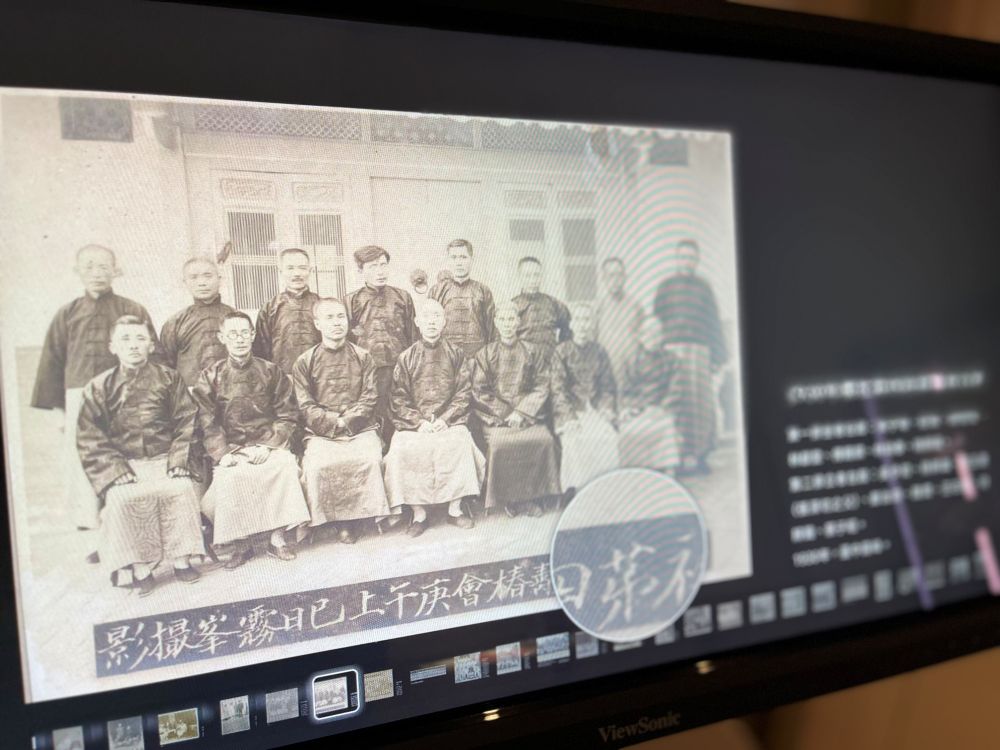
|Group Photo of the Oak Poetry Society's 3rd Shouchun Celebration, 1930|
Taken May 4 1929 at the Wufeng Lin Family Mansion's Great Flower Hall, when the 50th birthdays of Lin Yu-chun and Chuang Sung were being celebrated. Attendees included Lin Hsien-tang, Fu Hsi-chi, Chuang Sung, Lin Yu-chun, Lin Chieh-tang, Cheng Ju-nan, Chen Huai-cheng, Chhòa Chú-chiau, Wang Shih-peng, Wu Tzu-yü, and Lin Yao-ting. The Oak Poetry Society began holding shouchun gatherings in 1926, and they served as both poetic society gatherings and celebratory events.
NMTL20170240128-007 / Donated by the family of Wu Te-kung
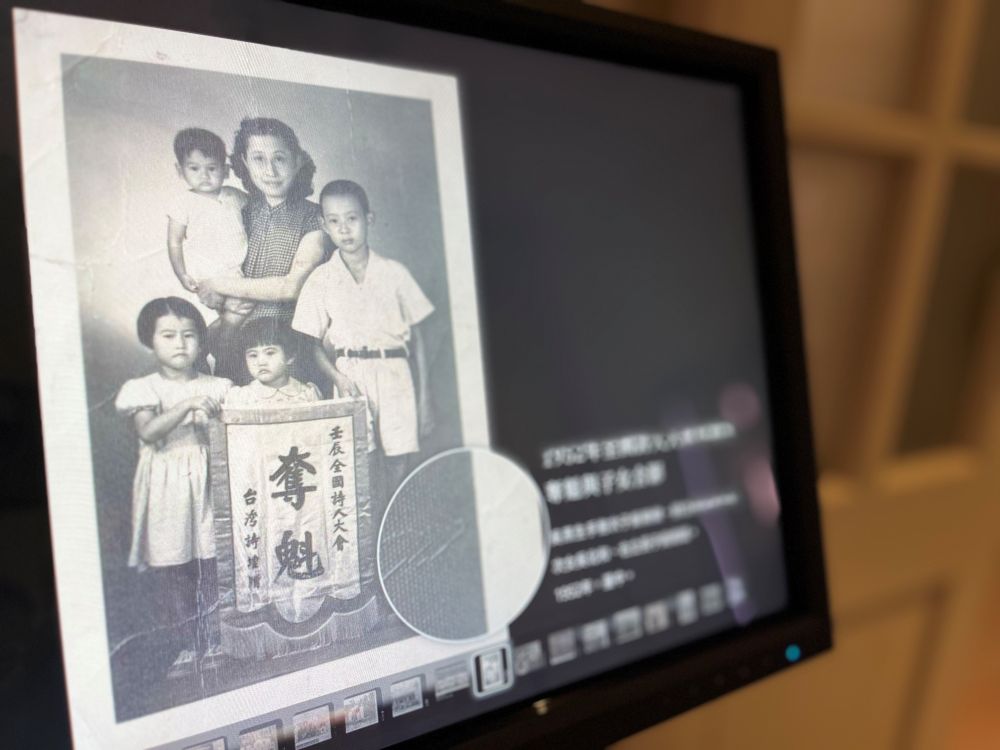
|Group Photo of Wu Yan-sheng and Children after Winning First Prize at the National Poets' Congress, 1952|
In 1952, poetry societies across Taiwan organized the National Poets' Congress. Wu Yan-sheng, then 38 years old, won first place with her seven syllable quatrain, “Elegy for Patriotic Qu Yuan.” The poem reads:
“He, the noble spirit of orchids and angelica, imbued verse with his own being; His loyal heart moved even spirits and gods.
Across a thousand years, only Jia Yi truly knew him; In summoning his spirit, my tears fall upon the banks of the Miluo."
Chia Ching-teh and Lin Hsiong-yang served as that year's "left" and "right" lyricists (judges), respectively. In the photo, Wu Yan-sheng is holding the first-place banner alongside her children Wu Nan-hsiong, Wu Bei-hsiang, Wu Bei-he, Wu Nan-jun, capturing a precious moment where family life and poetic glory converged.
NMTL20170270003 / Donated by Wu Bei-he

1. Privacy protection policy.
Personal privacy has become the main concern of users when browsing in the online world. The National Museum of Taiwan Literature (hereinafter referred to as the museum) has specially created a privacy protection policy. How to collect and use data", "Cookies, IP address", and "Protection and Use of Personal Data" to explain and declare:
(1) How to collect and use personal data:
In order to provide you with the best on this website The website service, according to different pages, will ask you to provide relevant personal information. The scope is as follows: This website is when you use the system function forms such as e-newslet subscription, group tour reservation, event registration, joining literary friends and publishing seminar information , Will retain the name, email address, contact method and usage time you provided.
(2) Cookies and IP Address:
When a user visits this website, the server will record relevant behaviors by itself, including the IP address of the connected device, time of use, browser used, browsing and click data records Etc., as a reference for us to improve our website services, this record is an internal application and will never be published.
(3) Protection and utilization of personal data:
The hosts of this website are equipped with various information security equipment such as firewalls, anti-virus systems and necessary safety protection measures to protect the website and your personal data. We adopt strict protection measures. Only authorized personnel can access your personal data. The relevant processing personnel have signed confidentiality contracts. Anyone who violates confidentiality will be punished by relevant laws.
Although this website will do its utmost to maintain the user’s personal data (not misused or disclosed), because the transmission of network data cannot ensure 100% security, this website cannot be sure or guarantee that the user’s or The data we send to users is completely secure. Regarding the above risks, users must be asked to bear them.
Unless you obtain your consent or other special provisions of laws and regulations, this website will never expose your personal data to a third party or use it for other purposes than the collection purpose.
2. Information Security Policy
The National Museum of Taiwan Literature (hereinafter referred to as the museum) respects and protects your security and privacy protection while using the Internet, in order to help you understand how the "National Museum of Taiwan Literature Global Information Network" protects your use of various services on this website For security, and how to collect, apply and protect the personal information you provide, please read the privacy protection and security policy of the "National Taiwan Literature Museum Global Information Network". Please read the following instructions carefully. You are also welcome to tell us your thoughts. If you have any comments or questions, please E-mail to twp@nmtl.gov.tw for
any unauthorized attempts to upload or modify the information provided by the library All services and related information activities are strictly prohibited and may violate the law. For site security purposes and to ensure that the service will continue to serve all Internet users, this site provides the following security measures:
. Use a network intrusion detection system to monitor network traffic to identify unauthorized attempts to upload or change, web page information, or sabotage.
. Install a firewall to prevent illegal intrusion, destruction, or theft or destruction of data, to avoid illegal use of the website, and to protect the rights of users.
. Install anti-virus software to scan for viruses regularly to provide users with a safer web browsing environment.
. Simulate hacker attacks from time to time, exercise system response procedures when security incidents occur, and provide appropriate security defense levels.