Home/Literary Panorama/The Path of Learning: Days of Studying, Testing, and Camaraderie/
Back
Not Just Writing: Side Hustles Are Nothing New!
Not Just Writing
Side Hustles Are Nothing New!
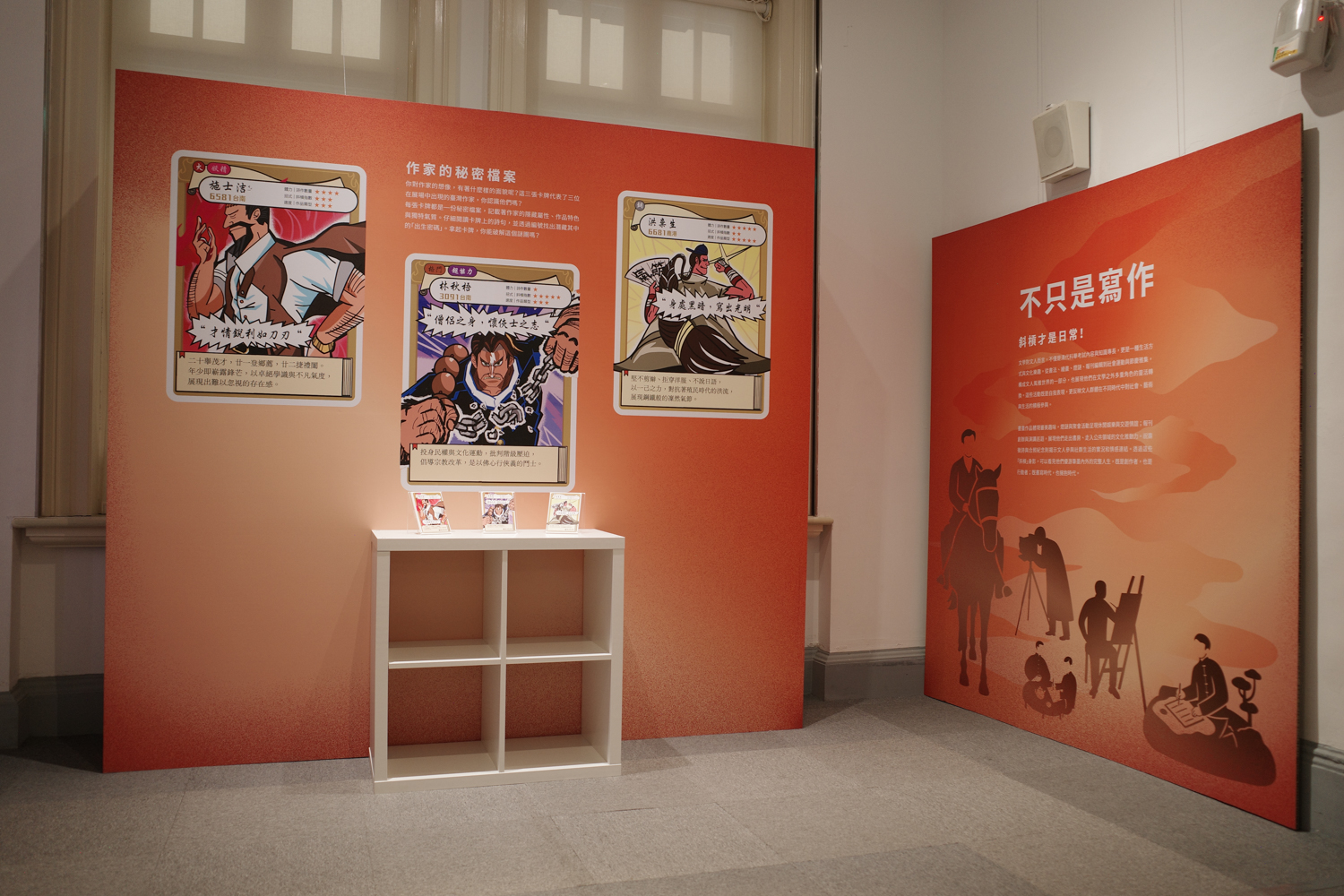
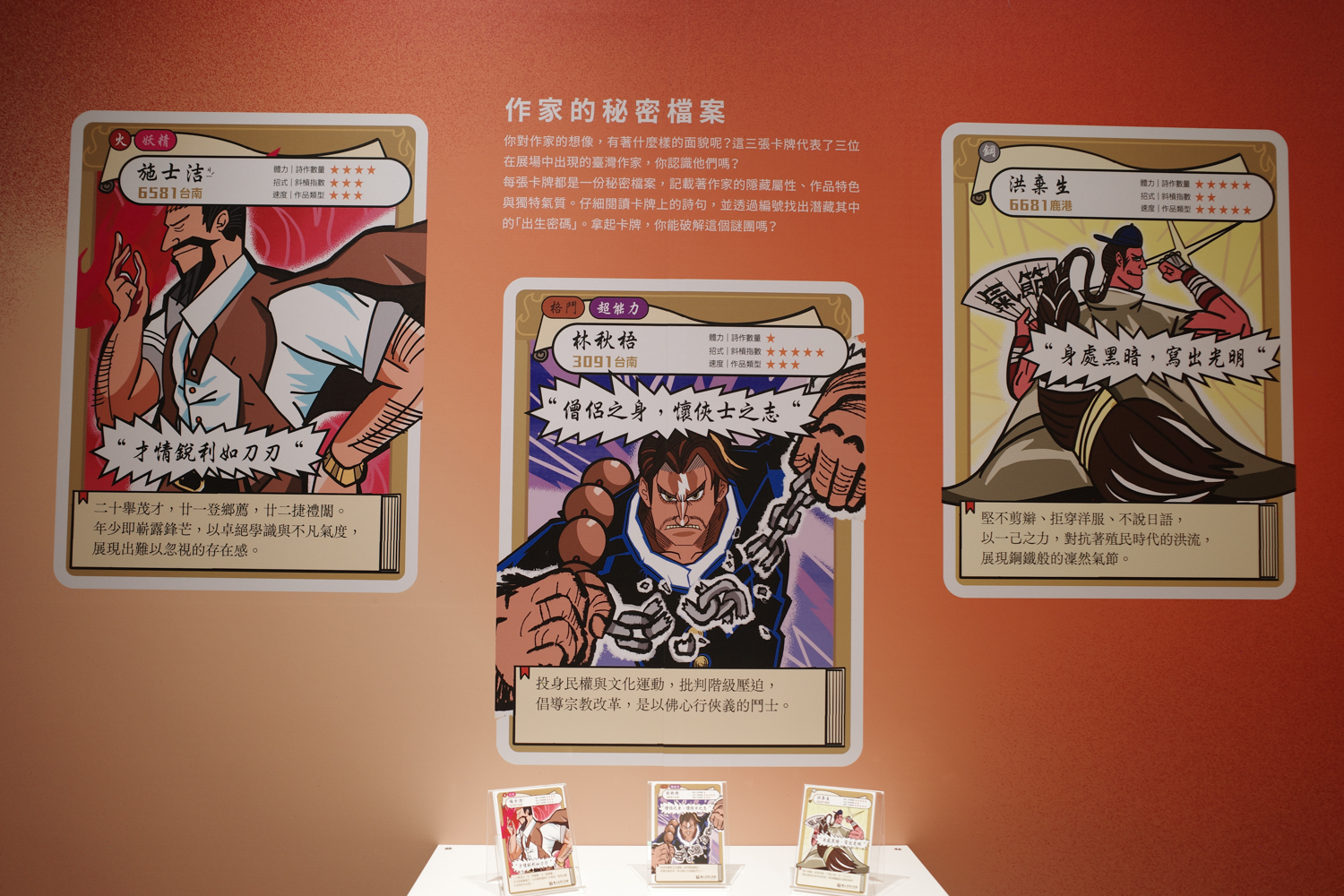
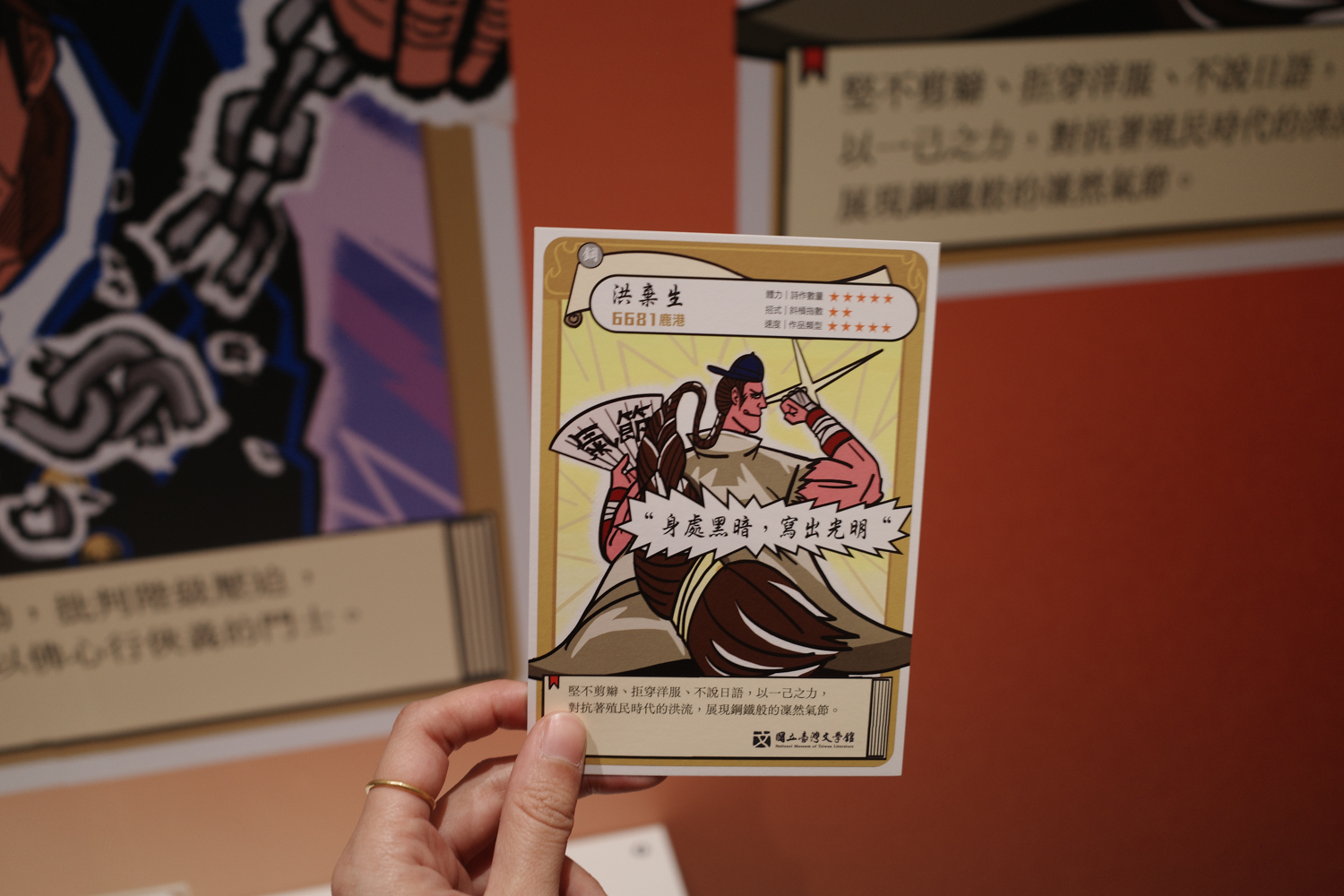
For the literati, literature was not just a matter of test material for the Qing imperial examinations, or necessary workplace knowledge—it was both a way of life and a form of cultural entertainment. First calligraphy, painting, lantern riddles, and editing of periodicals, then social movements and elegant festival celebrations formed a part their distinctive lifestyle, and show us how they transitioned and applied their skills into multiple roles outside of literature. More than simple self-expression, these activities reflect how scholars of different eras engaged with society, the arts, and life as a whole.
Through painting and calligraphy we can grasp their interest in aesthetics; through their lantern riddles and events at meetings, we can see they entertained themselves; and through the founding of periodicals and their travels on the speaking circuit, we can understand how scholars left the ivory tower and entered the realm of public culture. And through their group photos and requests for birthday poems, we learn of how literati took part in community life and built meaningful connections. Through this many-faceted approach, we gain a more well-rounded understanding of their lives as creatives, and as activists; and as people who wrote about contemporary changes while also embracing them.
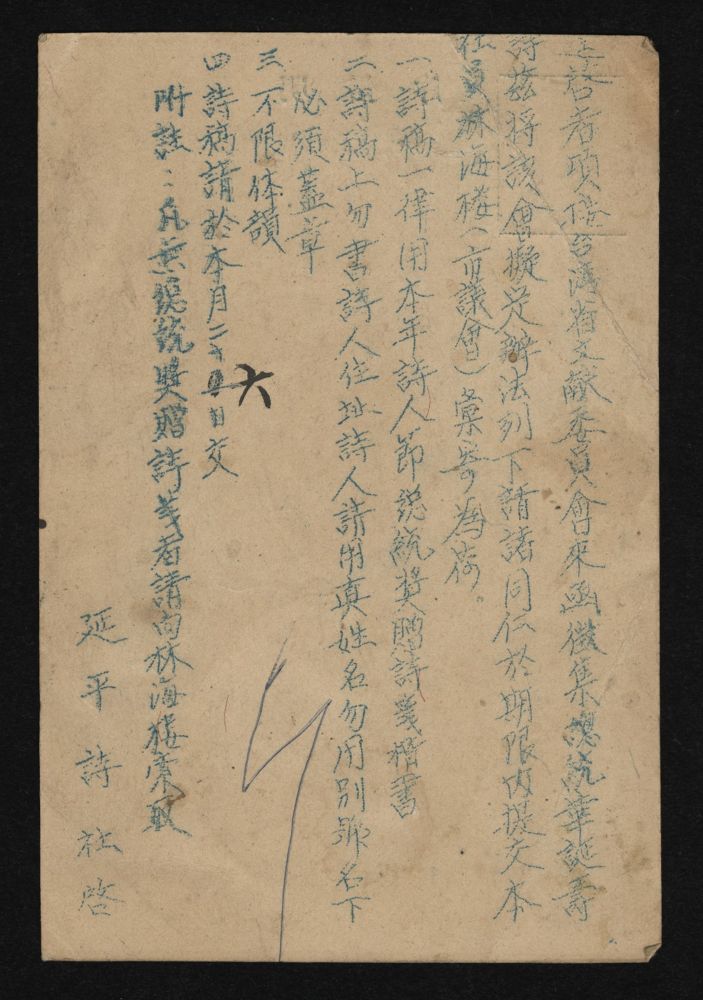
|Postcard from the Yanping Poetry Society requesting submissions, postwar|
This postcard was sent by the Yanping Poetry Society to member Hsu Ping-ting. It notifies him that the Taiwan Provincial Literature Committee was soliciting poems wishing the R.O.C. President a happy birthday, and encouraged society members to submit their work. Poetry solicitations like these appeared often during the Japanese colonial era and postwar, and poets could hardly avoid being asked to make submissions as a matter of courtesy. A surviving poem by Hsu Ping-ting titled "Best Wishes on President Chiang's Sixtieth Birthday" is likely related to this activity.
NMTL20060310068 / Donated by Hsu Ping-ting
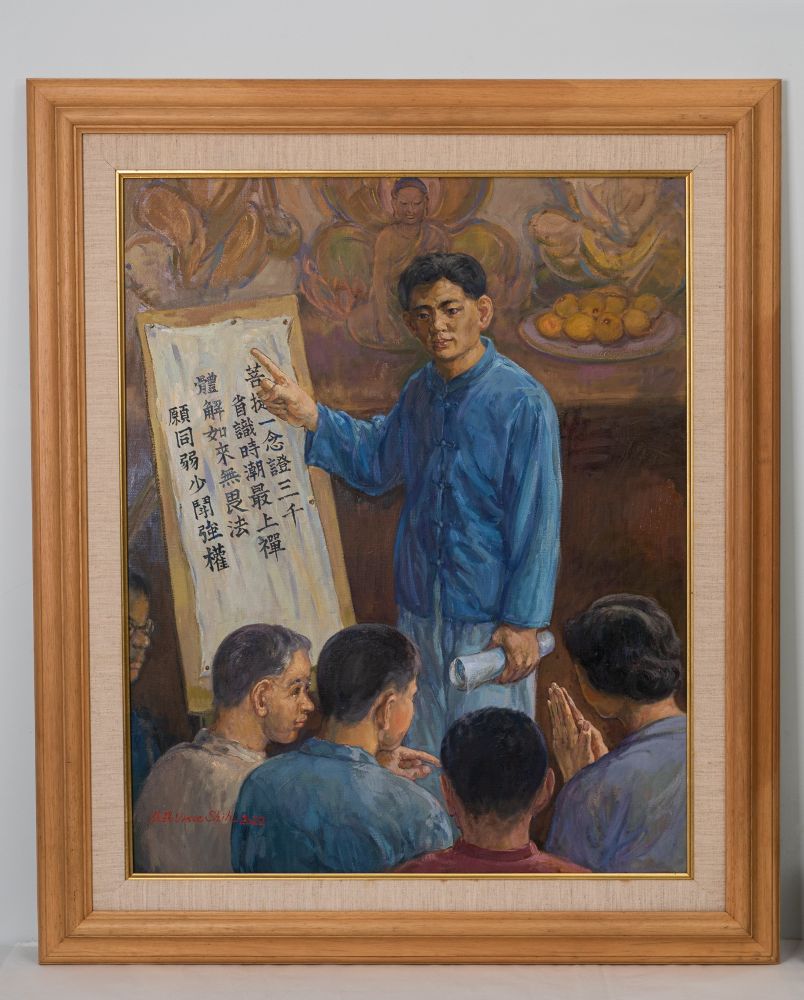
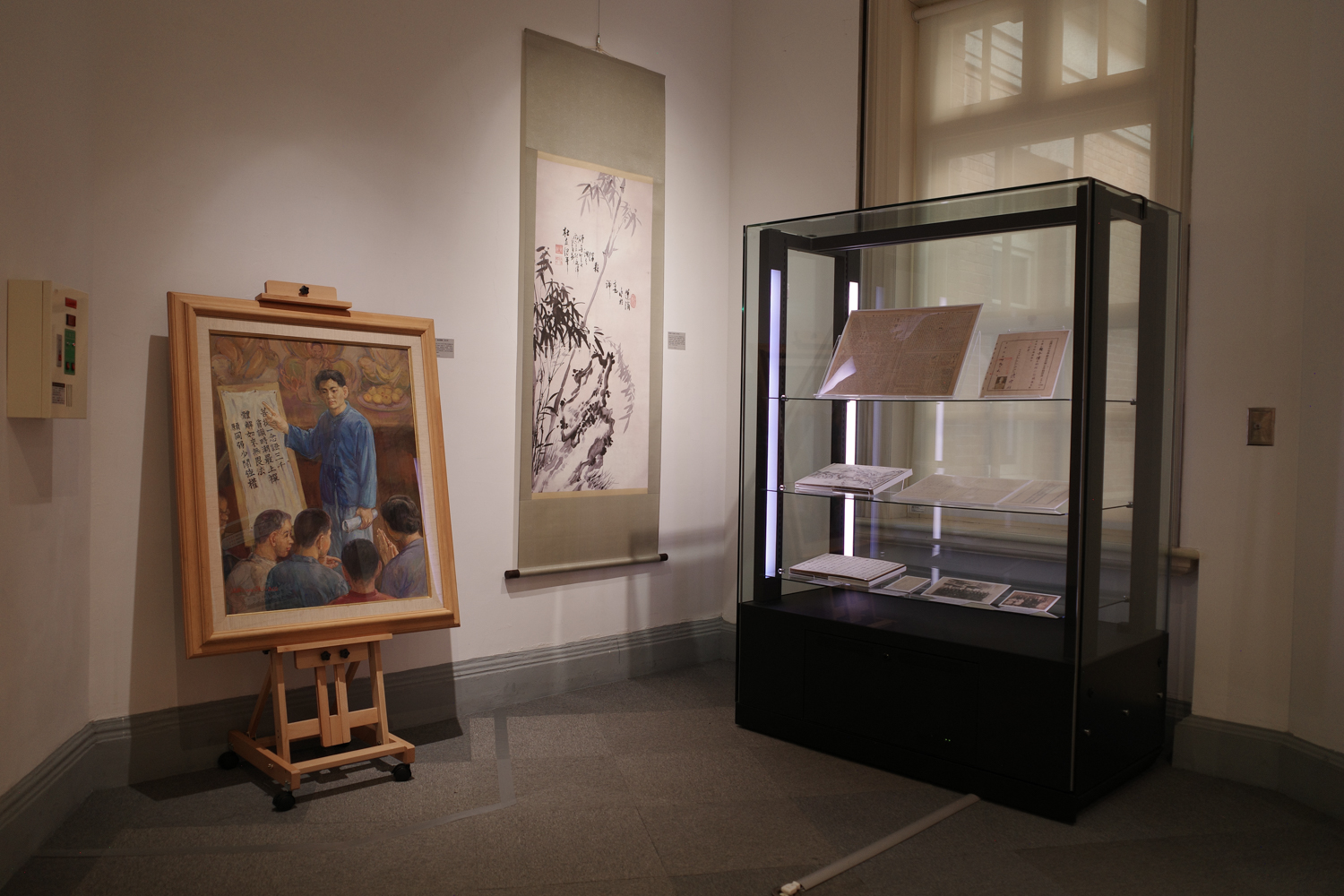
|Painting of Lin Chiu-wu, Shih Ping-hsi, 2022|
This painting depicts Lin Chiu-wu (1903-1934) speaking at Kaiyuan Temple in Tainan. He is pointing to this poem:
"In a moment of awakening, one knows the vastness of reality; to recognize the times is the highest form of Zen.
The Buddha's teachings remove my fear; I will fight against the strong on behalf of the weak."
The poem expresses his awareness of the changing times and the strength of his character in resisting oppression. Lin Chiu-wu was a monk, poet, and member of the Taiwan Cultural Association, who vigorously expressed his spirit of resistance to tyranny in both writing and action.
NMTL20230170001 / Donated by Shih Ping-hsi
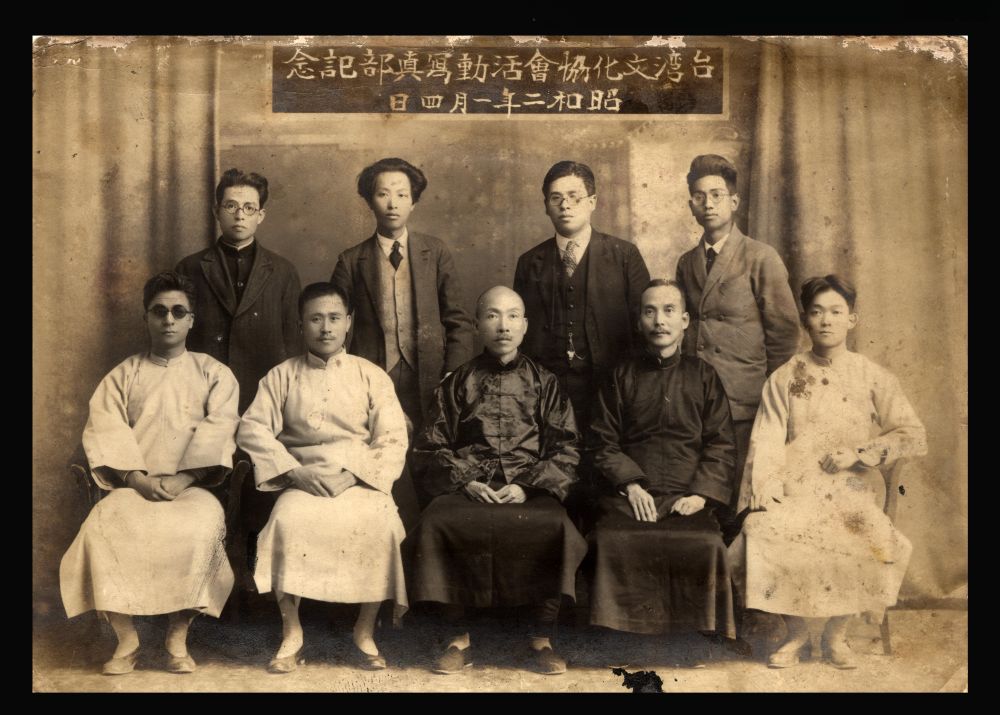
|Commemorative Group Photo of the Taiwan Cultural Association's Photography Team, 1927|
Taken on January 4, 1927, this photo commemorates the touring lecture activities organized by its Photography Team. Lu Bing-ding, Tsai Pei-huo, Lin Hsien-tang, Lin Yu-chun, and Lin Chiu-wu can be seen in the front row. Lin Chiu-wu was a monk, poet, and member of the Taiwan Cultural Association, and served as benshi (narrator) for the "Beautiful Taiwan Troupe," during the presentations which the Photography Team organized. This photo testifies to the active participation of Cultural Association members disseminating new ideas and promoting public enlightenment.
NMTL20190160288-001 / Donated by Lin Chang-feng
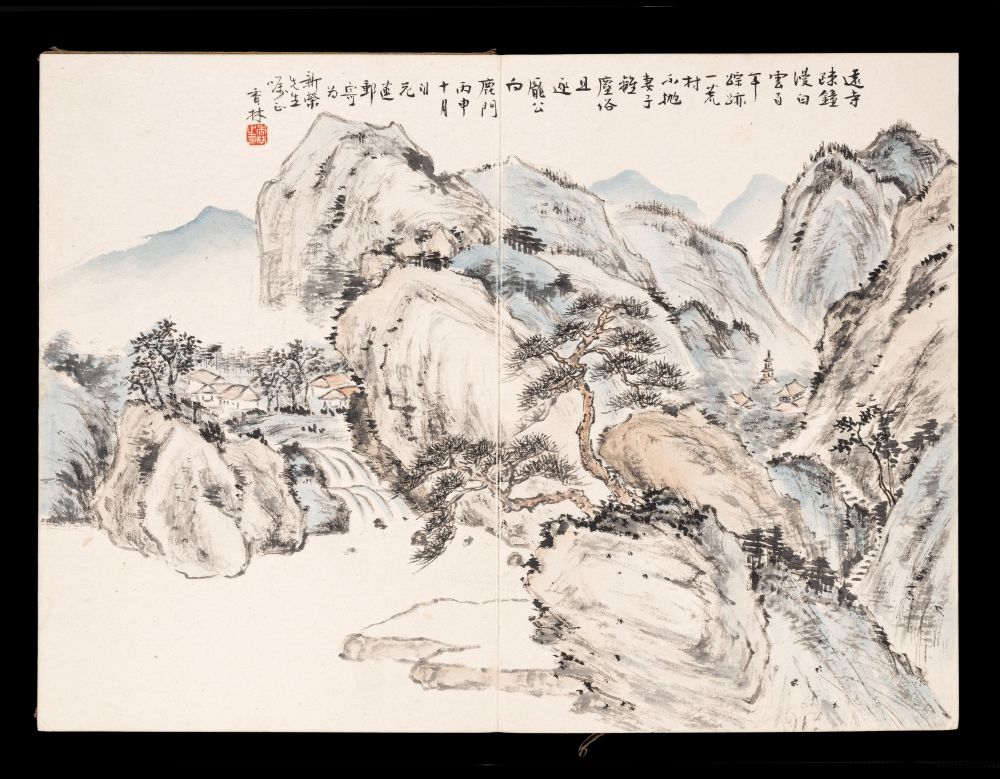
|Landscape Painting, Luo Hsiang-lin, 1956|
Luo Hsiang-lin sent this piece from Hualien to Wu Hsin-jung in October 1956. The painting depicts a secluded mountain forest, accompanied by the poem:
"From a distant temple, the scattered sounds of bells drifts through white clouds; a century remains alive in a deserted village.
I do not abandon my wife and children by leaving secular life; I follow Master Pang to the Deer Gate."
The verses evoke the life of a recluse in the mountains, reflecting Luo's shift in attitude after relocating to Hualien. Luo Hsiang-lin was a poet, painter, and photographer. In his early years, he studied under Chao Yi-shan, and later became a member of the Xing and Ying Poetry Societies. He was active in poetry and art circles during the Japanese colonial period and postwar.
NMTL20060020004 / Donated by Wu Nan-tu
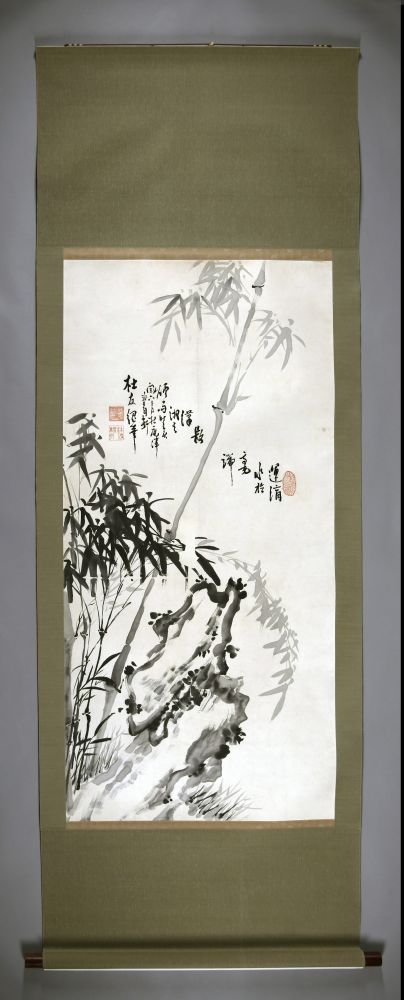
|Ink Bamboo Painting, Du You-shao, 1911|
Painted in June 1911 at the Stargazing Pavilion in Lukang, this painting bears the inscription: "I move the dripping water to the tip of the brush, scattering the mists and rains of Xiaoxiang," and is stamped with three seals: "Yao of Shen, Wei, and Chi" "Yao Chi", and "Seal of Du You-shao."
Du You-shao, also known as You-shao (style name Yao Chi), lived in Lukang, and excelled in poetry and prose. He was also skilled in medicine, painting, calligraphy, and the appraisal of cultural artifacts, and was a member of the Lujiang and Daye Poetry Societies. His neighbor Hung Chi-sheng once praised him as a renaissance man: "Everyone regards him as a connoisseur, yet few know the breadth of his talents."
NMTL20170130001 / Donated by Tu Kuo-ch'ing
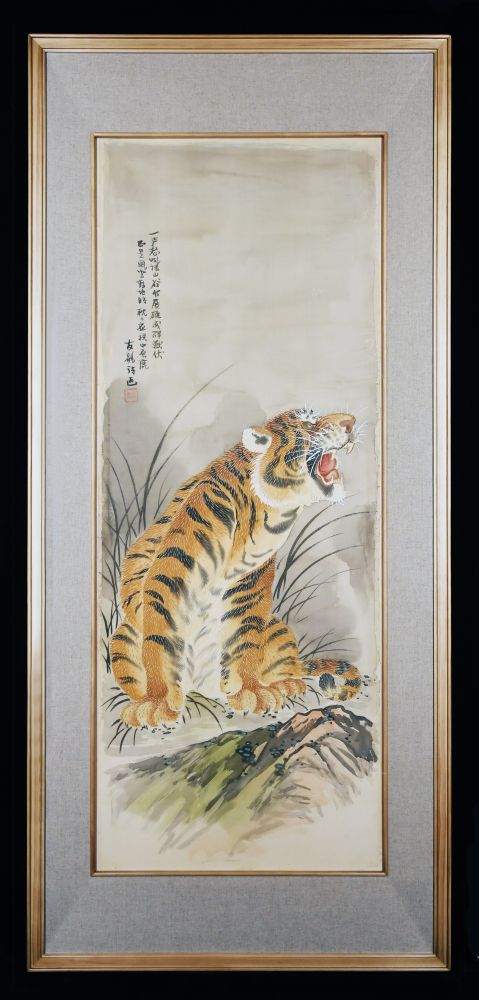
|Painting of Growling Tiger, Cheng Kun-wu, date unknown|
This painting depicts a fierce tiger perched upon a stone, roaring with his head held high, exuding an aura of majesty. The inscribed poem reads:
"A roar shakes the valley; the sudden display of power cows all beasts.
In these times of great change, he should fix his eyes on the deer of the Central Plain."
Cheng Kun-wu (style name He, also known as Ch'ian Lao), was a scholar from Fengshan who produced poems, prose, calligraphy, and paintings, and was especially known for his paintings of tigers. He and Lin Yu-shan were nicknamed the "Twin Titans of Tiger Painting." Cheng was very active in both poetry and art, working in a variety of styles. In 1924, he was recognized by the Toyo Art Academy in Japan.
NMTL20140130130 / Donated by the family of Wei Ch'ing-tê
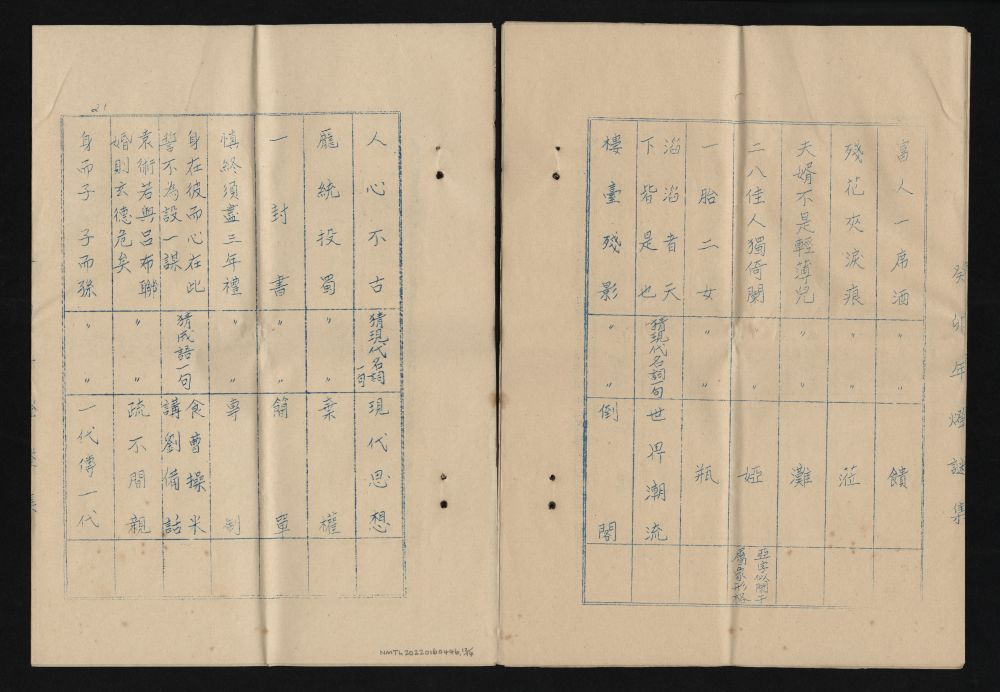
|Collection of Lantern Riddles from the 1963 Lantern Festival, Lo Li-yun, 1963|
During the 1963 Lantern Festival, the Keelung Community Service Center held a three-day lantern riddle competition. Lo Li-yun compiled this collection of riddles from that event. Some of the riddles in this booklet are based on guessing Chinese characters based on their components. For instance, what is a rich man's (富人) feast (一席酒)? Food offered (饋, the two parts meaning wine or food, and wealthy). Others are semantic: "People's hearts have changed," (人心不古) can be thought of as "modern thought." Lantern riddles, combining classical allusion and rhetoric, were a cultural activity that blurred the lines between literary gathering and festive entertainment.
NMTL20220160446 / Donated by the family of Kao Wen-chia
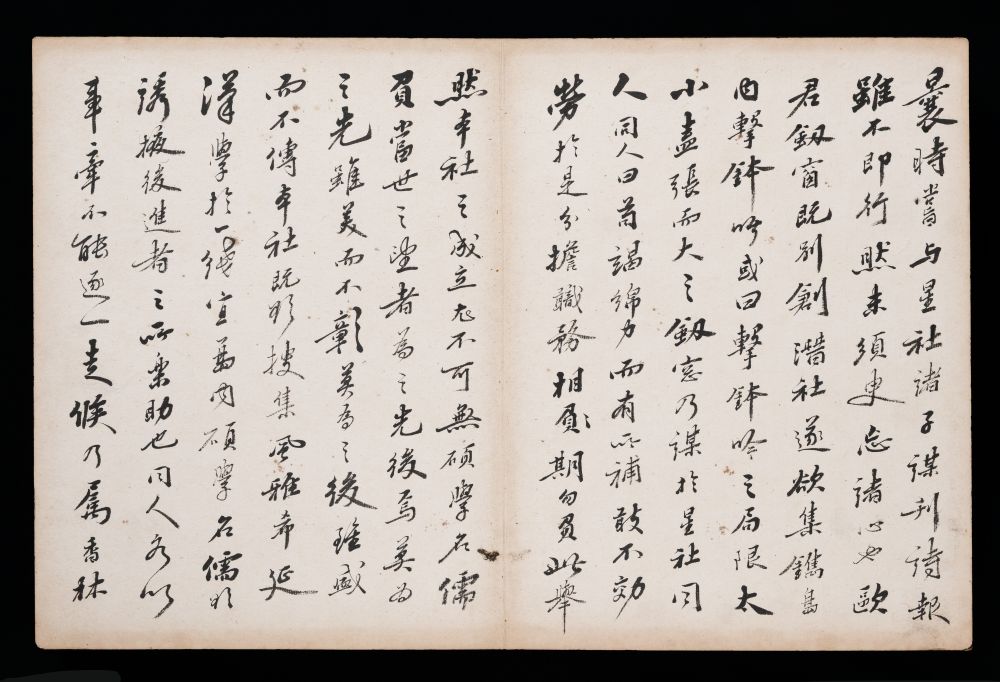
|Page from Signature Book for the Founding of Taiwan Poetry, 1924|
This album is a commemorative signature book, produced for the launch of Taiwan Poetry. The cover bears the inscription Fulun daya, a traditional phrase wishing success to literary enterprises, signed by Chang Ch'un-fu. Inside is the Founding Notice, written by Luo Xianglin and transcribed by Chen Xi’an, along with supporting signatures and a roster of Xing Society members.
It was Ou Ch'ian-chuang who called upon members of the Qian and Xing Poetry Societies to participate, in order to "give permanence to the poems of ji bo composition contests," showing how, beyond poetry society events, poets also promoted literary exchange through the editing and publishing of periodicals.
NMTL20230420001 / Donated by Chen Wei-cheng, Chen Jun-hua, and Chen Jun-ying
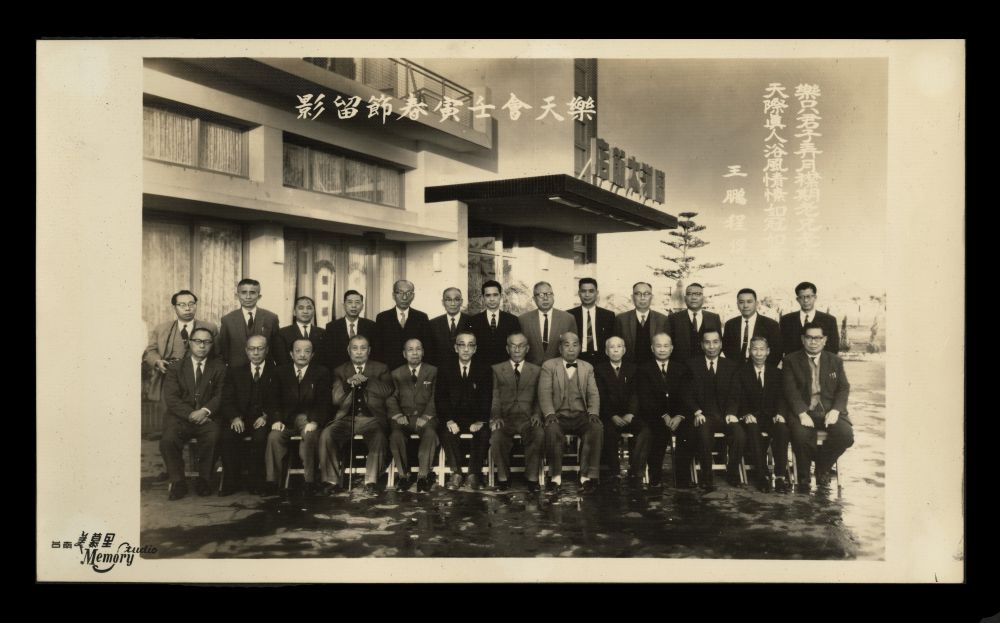
|Group Photo of the Letian Association during the 1962 New Year's Festival|
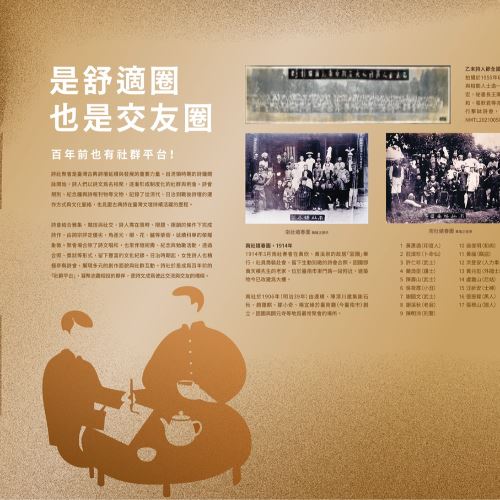
Taken during the New Year in 1962. The Letian Association held events continuously from its founding in 1933 through the postwar era. Its members included Hung T'ieh-t'ao, Tsai Chi-li, Chang Chen-liang, Yeh Shu-tien, Teng Yao-shan, and K’o Tzu-lu. Some of its members passed away in the postwar era. Hsu Ping-ting, Wang Peng-cheng, Wang Kai-yun, and Chao Ya-fu, and others are present in the photo. This photo shows the importance of the Letian Association as an important gathering for Tainan scholars to maintain their friendships and enjoy leisure activities together in both the Japanese colonial period and the postwar era.
NMTL20220180001 / Donated by the family of Wang Te-chung
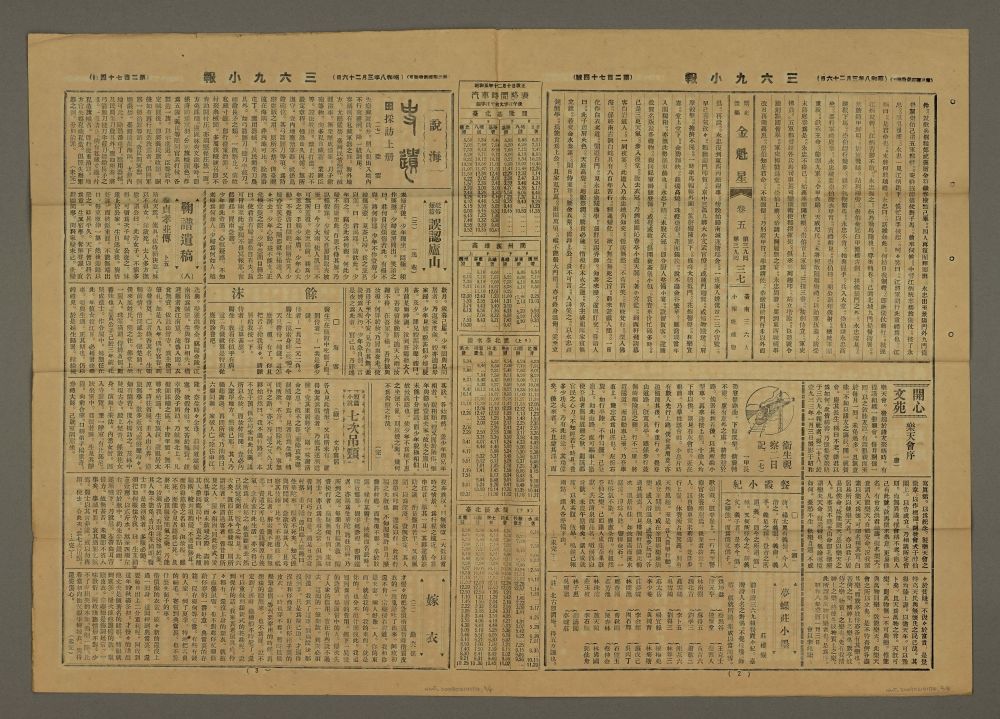
|Introduction to the Letian Association, in 369 Newspaper Issue 274, 1933|
This manuscript gives an account of how the Letian Association was founded in 1933. Formed by a group of writers who often gathered at the 369 Newspaper office, the Letian Association initially focused on birthday celebrations for members and their friends, but later developed into a regular social gathering. To avoid using the same name as the Forever Youthful Club (不老會) formed by Tainan writers Huang Hsing and Huang Hsi-ch’üan, Hung T'ieh-t'ao rechristened it the Letian Association, short for le tian an ming, or "happy-go-lucky." Its activities were centered around friendships and outdoor leisure activities—a more relaxed part of the lives of 1930s Tainan literati. As an important gathering for friends to maintain their relationships, the Letian Association remained active from the Japanese colonial era through the postwar period.
NMTL20090210174 / Donated by Su Hsin-yi
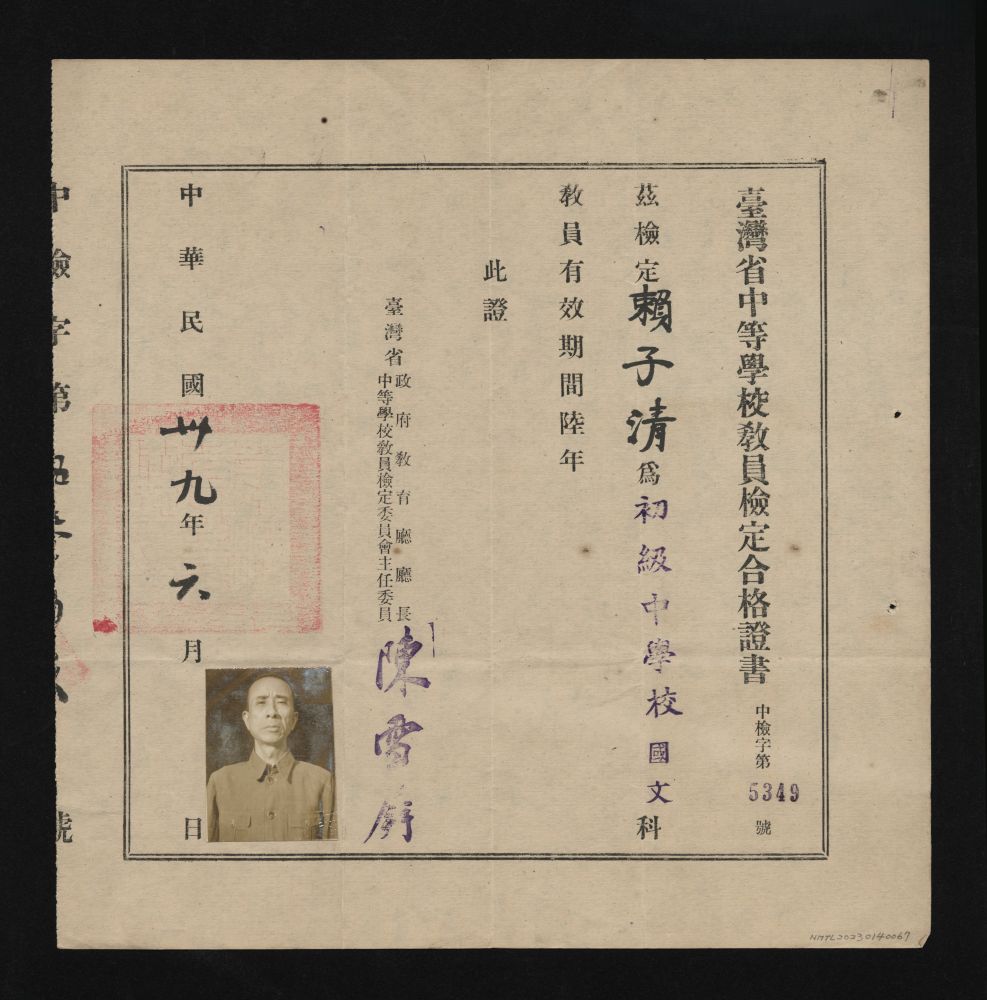
|Lai Tzŭ-ch'ing's Taiwan Province Secondary School Teaching Certification, 1950|
This shows that Lai Tzŭ-ch'ing passed the secondary school certification after the war and began teaching, devoting his life to Chinese language education. In the postwar era, many classically-trained scholars went into education. Besides teaching, he drew on the knowledge of poetry society members and attendees to conduct long-term research into the history of classical poetry and local literature. From the Anthology of Taiwan Poetry of the 1930s to post-war histories of poetry, classical scholars, and poetry societies, he gradually built a system of knowledge concerning classical poetry in Taiwan. He was also the chief editor of several volumes of the Chiayi County Gazette. This certificate attests to his abilities in education, as well as in literature and research.
NMTL20230140067 / Donated by the family of Lai Tzŭ-ch'ing
主辦單位 / 國立臺灣文學館

1. Privacy protection policy.
Personal privacy has become the main concern of users when browsing in the online world. The National Museum of Taiwan Literature (hereinafter referred to as the museum) has specially created a privacy protection policy. How to collect and use data", "Cookies, IP address", and "Protection and Use of Personal Data" to explain and declare:
(1) How to collect and use personal data:
In order to provide you with the best on this website The website service, according to different pages, will ask you to provide relevant personal information. The scope is as follows: This website is when you use the system function forms such as e-newslet subscription, group tour reservation, event registration, joining literary friends and publishing seminar information , Will retain the name, email address, contact method and usage time you provided.
(2) Cookies and IP Address:
When a user visits this website, the server will record relevant behaviors by itself, including the IP address of the connected device, time of use, browser used, browsing and click data records Etc., as a reference for us to improve our website services, this record is an internal application and will never be published.
(3) Protection and utilization of personal data:
The hosts of this website are equipped with various information security equipment such as firewalls, anti-virus systems and necessary safety protection measures to protect the website and your personal data. We adopt strict protection measures. Only authorized personnel can access your personal data. The relevant processing personnel have signed confidentiality contracts. Anyone who violates confidentiality will be punished by relevant laws.
Although this website will do its utmost to maintain the user’s personal data (not misused or disclosed), because the transmission of network data cannot ensure 100% security, this website cannot be sure or guarantee that the user’s or The data we send to users is completely secure. Regarding the above risks, users must be asked to bear them.
Unless you obtain your consent or other special provisions of laws and regulations, this website will never expose your personal data to a third party or use it for other purposes than the collection purpose.
2. Information Security Policy
The National Museum of Taiwan Literature (hereinafter referred to as the museum) respects and protects your security and privacy protection while using the Internet, in order to help you understand how the "National Museum of Taiwan Literature Global Information Network" protects your use of various services on this website For security, and how to collect, apply and protect the personal information you provide, please read the privacy protection and security policy of the "National Taiwan Literature Museum Global Information Network". Please read the following instructions carefully. You are also welcome to tell us your thoughts. If you have any comments or questions, please E-mail to twp@nmtl.gov.tw for
any unauthorized attempts to upload or modify the information provided by the library All services and related information activities are strictly prohibited and may violate the law. For site security purposes and to ensure that the service will continue to serve all Internet users, this site provides the following security measures:
. Use a network intrusion detection system to monitor network traffic to identify unauthorized attempts to upload or change, web page information, or sabotage.
. Install a firewall to prevent illegal intrusion, destruction, or theft or destruction of data, to avoid illegal use of the website, and to protect the rights of users.
. Install anti-virus software to scan for viruses regularly to provide users with a safer web browsing environment.
. Simulate hacker attacks from time to time, exercise system response procedures when security incidents occur, and provide appropriate security defense levels.