Home/Literary Panorama/Rewriting the Script: Unexpected Twists in Taiwan Literature and Screen Media /
Back
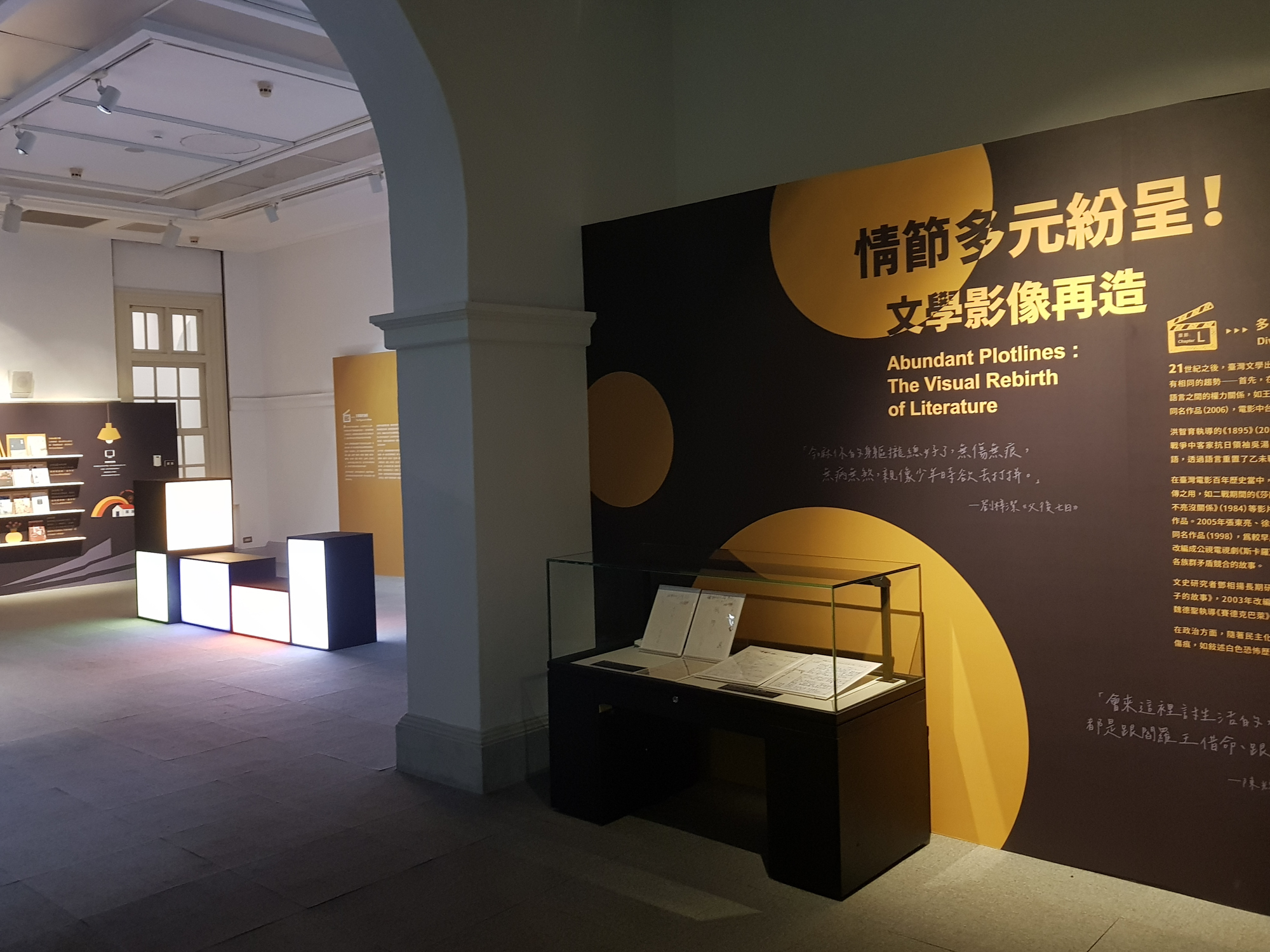
Abundant Plotlines: The Visual Rebirth of Literature

 Abundant Plotlines

 Diverse Coexistence: A New Age in Cinema
Since the 21st century, Taiwanese literature has developed new approaches to local storytelling. Contemporary film adaptations followed a similar trend, especially in addressing ethnic and linguistic aspects. Films began to explore the power dynamics between different languages and the ways they intersected with cultural identity. For instance, Wang Yu-lin and Marula Liu’s Seven Days in Heaven (2010), adapted from Liu’s 2006 work of the same name, blends Taiwanese and Mandarin voices on screen, evoking the layered linguistic rhythms and multicultural textures of contemporary Taiwan.
Hung Chih-yu’s 1895 (2008), adapted from Li Chiao’s script My Love to My Mother Earth, released in the same year, depicts Hakka anti-Japanese leaders during the Yiwei War, primarily in Hakka, with Taiwanese and Japanese interspersed, reframing ethnic perspectives of the war.
Throughout the century-long history of Taiwanese cinema, Indigenous peoples were often portrayed through an imperial gaze, treated as objects of curiosity, or used for political propaganda, as seen in films such as Sayon’s Bell, which was released in 1943 during World War II, and postwar works like Happenings in Ali Shan, released in 1950, and It Doesn’t Matter Whether It Shines or Not, released in 1984. It was not until the 1990s that films began to center Indigenous narratives. Among the earlier adaptations of Indigenous literature was The Sage Hunter, released in 2005 and directed by Tony Cheung and Cindy Hsu,based on Ahronglong Sakinu’s 1998 work of the same name. More recently, Chen Yao-chang’s Lady the Butterfly (2016) was further adapted into the PTS Taiwan television series Seqalu: Formosa 1867 (2021), which dramatizes the conflicts and encounters among diverse ethnic groups on the Hengchun Peninsula during the Qing dynasty, set in motion by the Rover Incident.
Historian Teng Hsiang-yang’s research on the Musha Incident led to his 2003 book Dana Sakura: The Truth of the Musha Incident and the Story of Hanaoka HATSUKO adapted into PTS Taiwan’s series Dana Sakura. His reportage also inspired Wei Te-sheng’s Warriors of the Rainbow: Seediq Bale, relesed in 2011.
In the political realm, as Taiwan’s democratization progressed, many directors began to confront the scars of political violence under the former authoritarian regime, producing works that depict the White Terror era, including Super Citizen Ko and Good Men, Good Women.
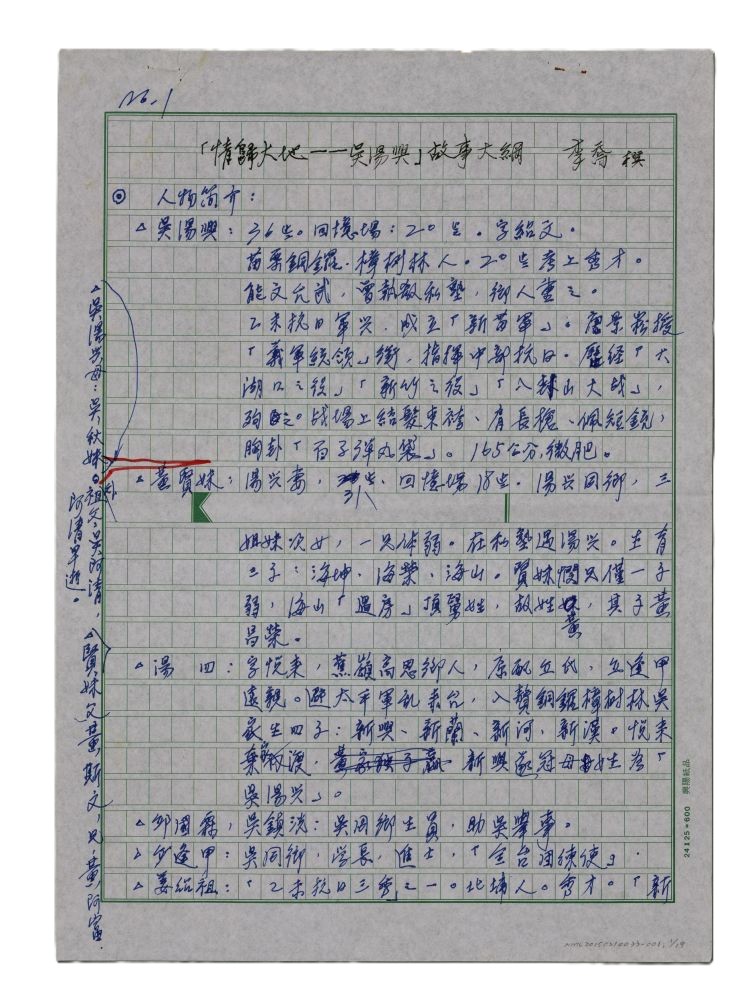
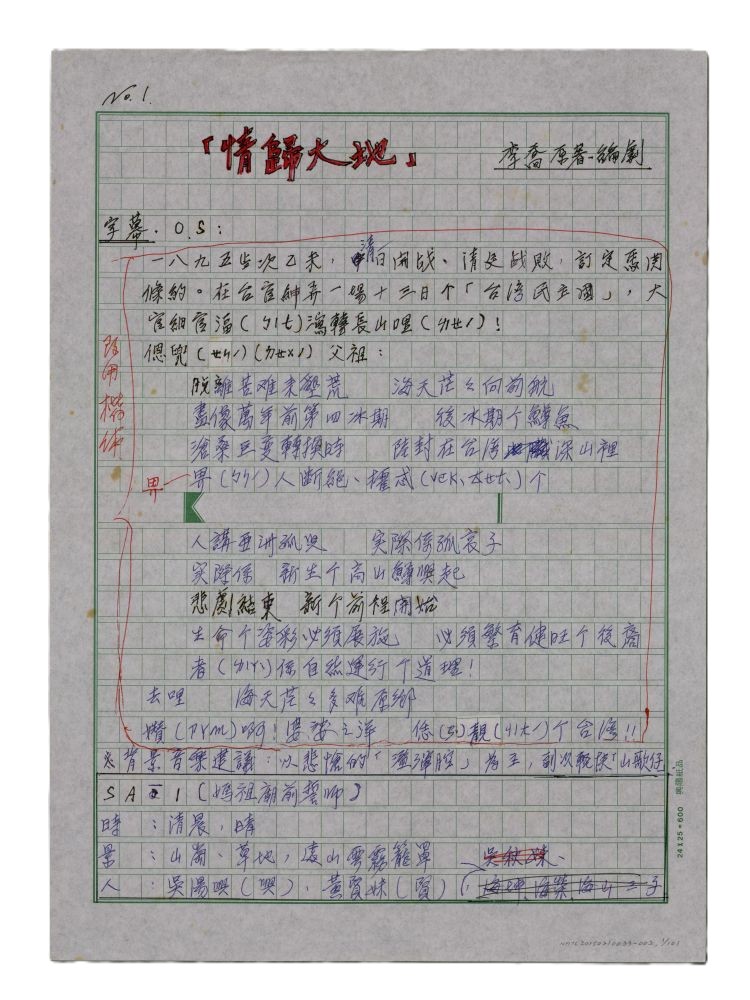
Li Chiao My Love to My Mother Earth Script and Story Outline Manuscripts, 2006 / Collection of The National Museum of Taiwan Literature
The story recounts the heroism of Hakka youths Chiang Shao-tsu and Wu Tang-hsing resisting Japanese occupation after the Qing ceded Taiwan following the First Sino-Japanese War. The author meticulously details subtitles, narration, background music, dialogue, and camera directions, with all dialogue in Hakka, reflecting the bravery and tragic heroism of the anti-Japanese fighters. Adapted into the 2008 film 1895 (also known as Blue Brave: The Legend of Formosa in 1895), it is one of the first modern Taiwanese films to feature Hakka as its main language.
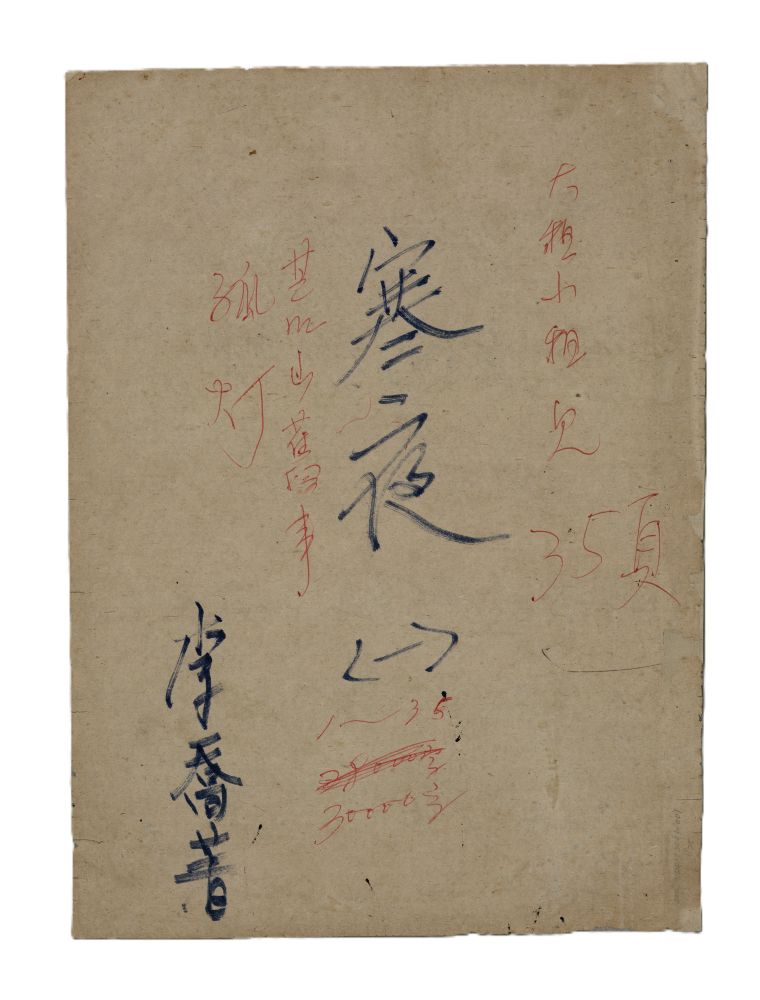
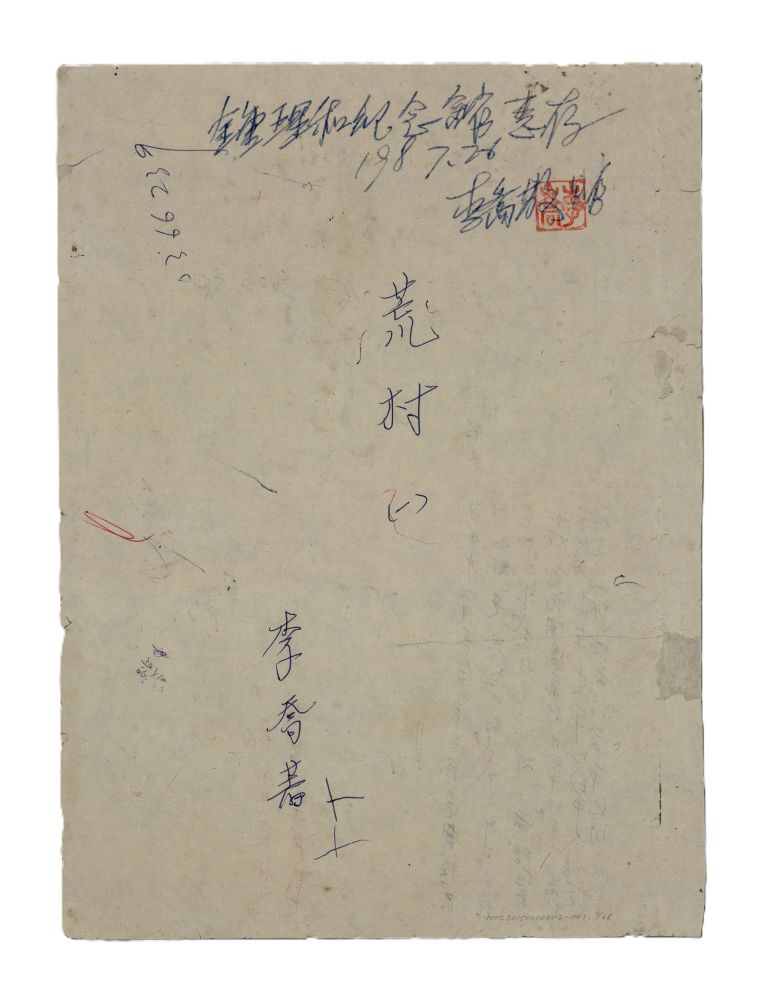
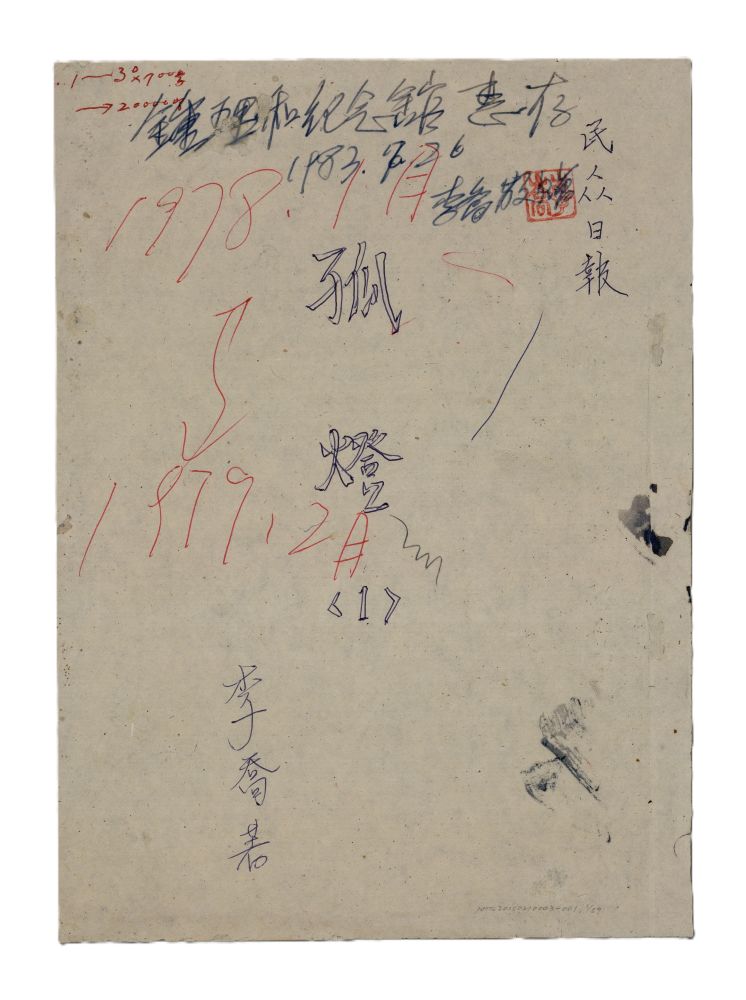
Li Chiao The Trilogy of Wintry Night Manuscript, 1975 / Collection of National Museum of Taiwan Literature
The Trilogy of Wintry Night consists of three novels: (Wintry Night), (The Desolate Village), and (The Lonely Lamp). Although each of the three novels has distinct stories,
characters, and settings and can stand alone as full-length works, together they chronical the intertwined histories of the Peng and Liu families - from their initial settlement, through struggles and survival, to the flourishing of later generations. Interwoven with major events in Taiwan’s history, the trilogy forms a continuous narrative spanning different eras, creating a sweeping family saga that Yeh Shih-tao praised as a “river novel.” (Wintry Night), set in Miaoli’s Fan-tzai-lin during the Qing period, depicts the hardships and ordeals of the Peng A-chiang and Liu A-han families as they fight to survive and defend the land they cultivated. The novel reflects not only the settlers’ arduous pioneering life but also the ethnic conflicts of the time.
 Nationwide Reading: Literature Meets Television
By the late 1990s, the government allowed foreign film imports, challenging Taiwan’s film industry and shrinking its scale. Meanwhile, television flourished with the emergence of cable channels, PTS Taiwan, and FTV Production House. To compete, networks produced high-quality dramas to build reputation, sparking a wave of literary adaptations for TV around 2000.
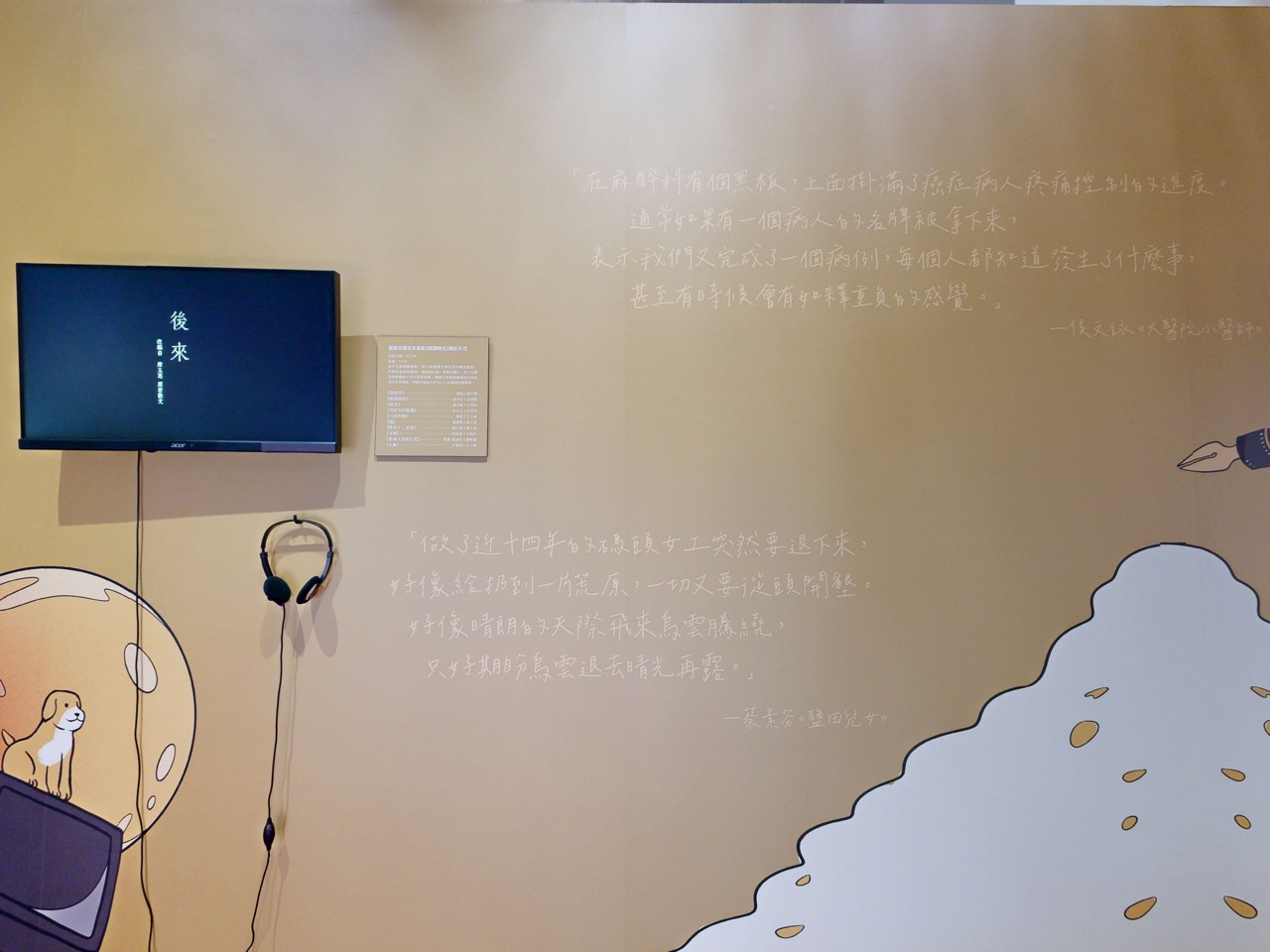
 Gazing at a Century of Taiwan Reading Taiwan Literature Highlights
Publication date: 2015 / 長度:Length: 10:24
Initiated by the Ministry of Culture, this project adapts ten Taiwanese literary works into dramas. Spanning themes from the personal to the national, family to society, and realism to the magical, the series features seven directors paying tribute to ten writers. It invites viewers to reflect on a century of Taiwan’s past and present. The complete works are available to watch for free on YouTube.
The Newspaper Carrier Yang Kuei X Cheng Wen-tang
Late Wind, Gentle Rain Liu Da-ren X An Che-i
(Afterwards) Liao Yu-hui X Wang Ming-tai
Fin de Siècle Splendor Chu Tien-wen X Shen Ko-shang
(The Walking Tree) Chi Chi X Wang Hsiao-ti
Moth Chang Hui-ching X Cheng Wen-tang
(Birth of the Twelve Constellations) Lo Yi-chin X Liao Shih-han
The Refrigerator Ko Yu-fen X Wang Ming-tai
(The Old Sailor Romabik) Syaman Rapongan X Cheng Yu-chieh
(Elephant) Fish Wang X Wang Hsiao-ti
In June 1997, FTV Production House launched, and the following year introduced the “Taiwan Writers’ Theatre,” bringing classic works of writers such as Yang Ching-chu, Lin Suang-pu, Chi Teng Sheng, Yeh Shih-tao, Tzeng Ching-Wen, Wang Chen-ho, Li Chiao, Wang To, Liao Hui-ying, Wang Pen-hu, Hsiaoyeh, A-Sheng, Chen Jo-hsi, and Tong Fang-po to the small screen with fruitful results.
“Taiwan Writers’ Theatre” Full Series-->
In July 1998, PTS Taiwan launched and introduced its inaugural literary dramas, adapting literary works by Tsai Su-fen, Ai Ya, and others into television series.
Adapted from Ai Ya’s work of the same name / Once
Adapted from Tsai Su-fen’s work of the same name / Children of the Saltpans
From 2000 to 2003, PTS Taiwan adapted eight literary works into television series, all available for free viewing on the YouTube channel.
Adapted from Cheng Feng-hsi’s work of the same name / He Never Gives Up
Adapted from Liao Hui-ying’s work of the same name / Turning Red Lotus
Adapted from Li Chiao’s work of the same name / Wintry Night
Adapted from Wu Feng-chiu’s work of the same name / The Sun Shines First Behind the Mountain
Adapted from Pai Hsien-yung’s work of the same name / Crystal Boys (Highlights of Each Episode)
Adapted from Pai Hsien-yung’s work of the same name / Love's Lone Flower (Preview Version of Each Episode)
Adapted from Hou Wen-yong’s work of the same name / A Young Doctor in the Big Hospital
Adapted from Hou Wen-yong’s work of the same name / Dangerous Mind
In July 2003, Hakka TV launched and actively adapted literary works related to the Hakka community into TV dramas, all free to watch on YouTube.
Adapted from Kao Yi-feng’s work of the same name / Désincarnation (Part 1)
Adapted from Kao Yi-feng’s work of the same name / Désincarnation (Part 2)
Adapted from Chung Chao-cheng’s work of the same name / The Dull Ice Flower
Adapted from Wu Chin-fa’s (Youth Trilogy) / Those Were the Days
Adapted from Fang Zi’s (To Hualien Harbor) / Brave Forward
Adapted from Chung Wen-yin’s novel of the same name / Lonely River
In 2019, Hakka TV adapted five classic literary works by Lai Ho, including (Harvest), Three Unofficial Accounts from the Romance of the Slippery Eels, A Weighing Scale, Progress, and Mr. Snake, combining iconic characters and plots into a 12-episode drama.
Adapted from Lai Ho’s literary work / Survival
In 2015, the Ministry of Culture founded and produced Reading Taiwan Literature, combining ten writers and ten directors to create ten short film adaptations of literary works, all freely available on YouTube.
Reading Taiwan Literature Full Series
Yang Kuei X Cheng Wen-tang / The Newspaper Carrier
Liu Daren X An Che-i / Wan feng xi yu+E8
Liao Yu-hui X Wang Ming-tai / Afterwards
Chu Tien-wen X Shen Ko-shang / Fin de Siècle Splendor
Chi Chi X Wang Hsiao-ti / The Walking Tree
Chang Hui-ching X Cheng Wen-tang / Moth
Lo Yi-chin X Liao Shih-han / Birth of the Twelve Constellations
Ko Yu-fen X Wang Ming-tai / The Refrigerator
Syaman Rapongan X Cheng Yu-chieh / The Old Sailor Romabik
Fish Wang X Wang Hsiao-ti / Elephant
In 2017, TTV launched the second season of Reading Taiwan Literature, featuring four works, all freely viewable on YouTube.
Adapted from Wang Chen-ho’s work of the same name / Rose, Rose, I Love You
Adapted from Wu Cho-liu’s work of the same name / Doctor's Mother
Adapted from Wang Ting-kuo’s work of the same name / The Demon
Adapted from Li Wsei-ching’s work of the same name / Life Is Sweet
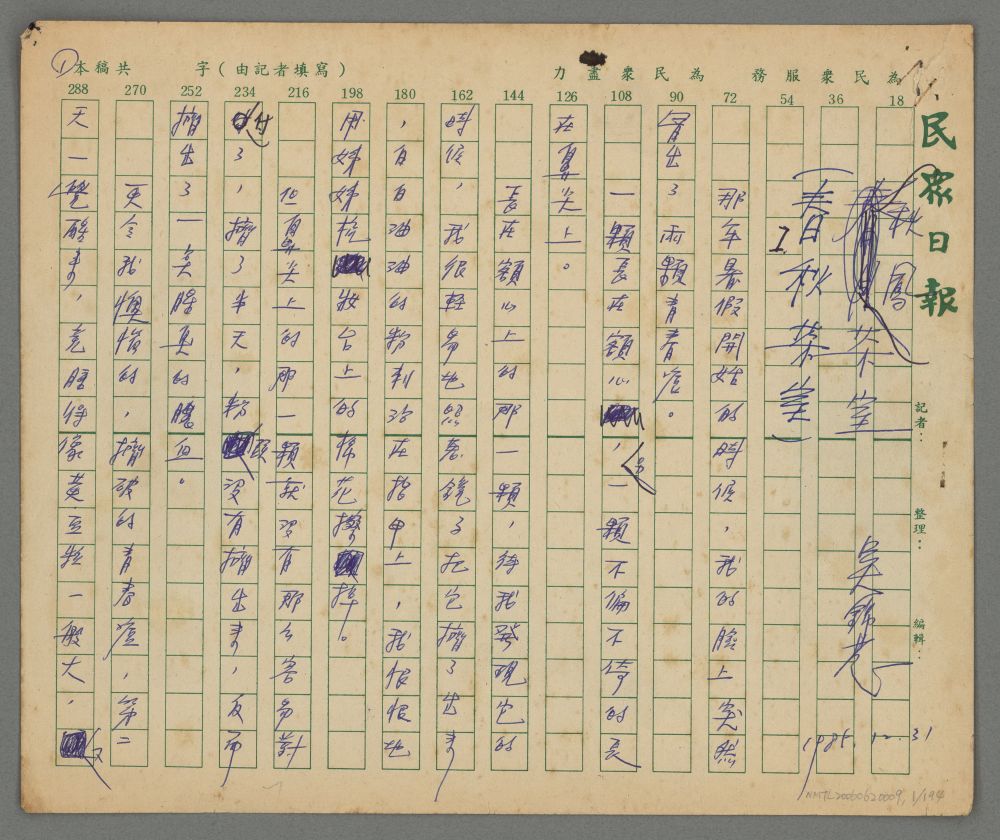
Wu Chin-fa My Mother’s Teahouse Manuscript, 1985 - 1987 / Collection of The National Museum of Taiwan Literature
The story centers on the daily lives of four teenage boys, set against the backdrop of the Spring and Autumn Teahouse run by one boy’s mother. It recounts how they attempt to rescue an indigenous girl, Chen Mei-li, sold into the teahouse by her parents. Written in lively Taiwanese vernacular, the novel captures youthful pursuits of love, but shows how, ultimately, harsh realities force the boys to mature, bidding farewell to innocence.
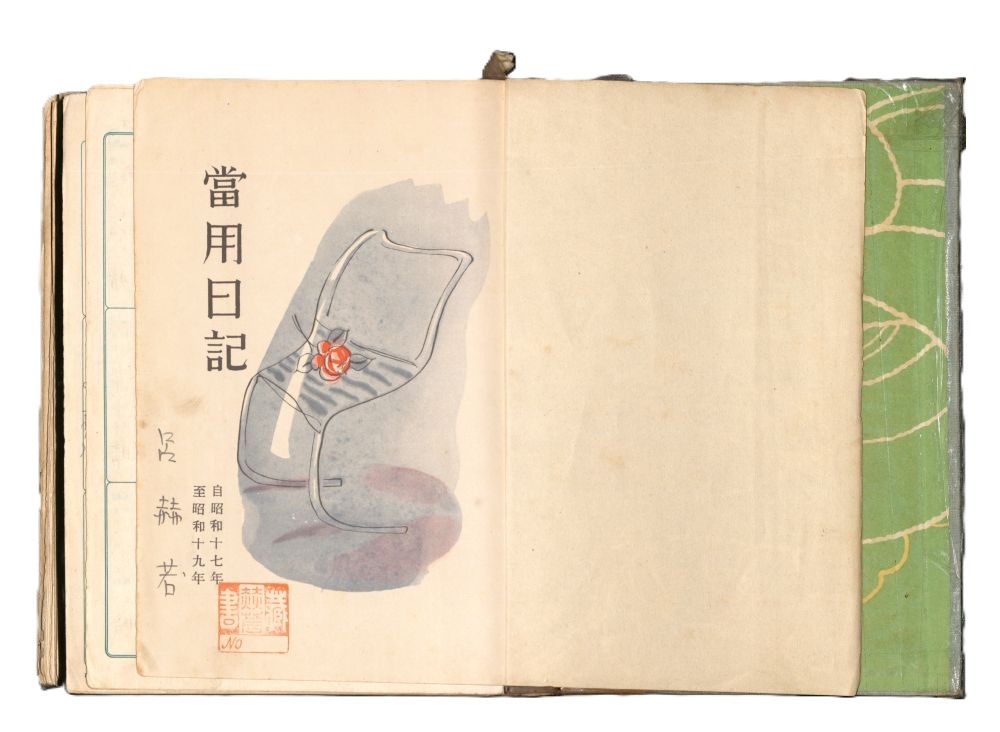
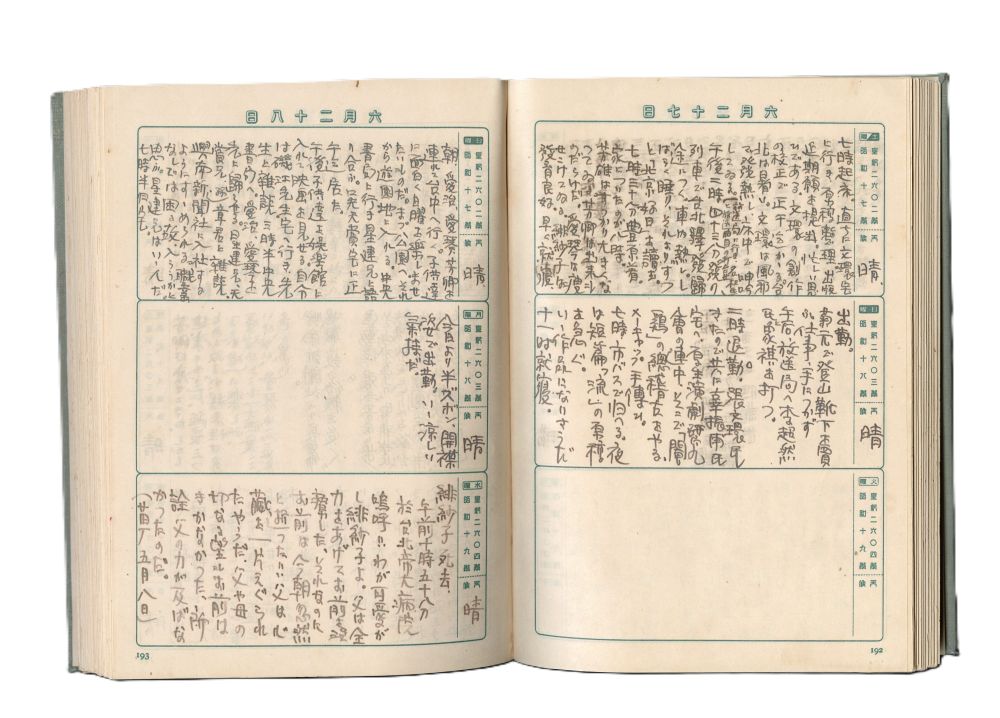
Lu Ho-jo Diary, 1942 - 1944 / Collection of The National Museum of Taiwan Literature
This is Lu Ho-jo’s handwritten Japanese diary, his only surviving manuscript, covering 1942–1944 - the peak of his literary and artistic activity. The Diary records his inner thoughts, literary activities, and the tenor of the era, making it a rare and invaluable first-hand source.
Lu Ho-jo (1914 - 1950?),born Lu Shih-tui in Tanzi, Taichung, was both a writer and vocalist.His works often exposed social injustice, exploring issues of class and gender. In 1935, his first story, The Oxcart, was published in the Japanese journal Literary Review, making him, after Yang Kuei’s The Newspaper Carrier, one of the few Taiwanese writers to enter the Japanese literary world. In 1944, he published the collection Autumn, the first stand-alone volume by a Taiwanese author during Japanese rule. After WWII, he became editor-in-chief of Kuangming News and engaged in underground resistance before going into hiding. He later disappeared, with one account claiming that he died from snake bites in 1950 at the Luku Armed Base. After his disappearance, many of his manuscripts and books were buried and decayed, but Diary was preserved by family members because of its references to his children, making it his only surviving manuscript.
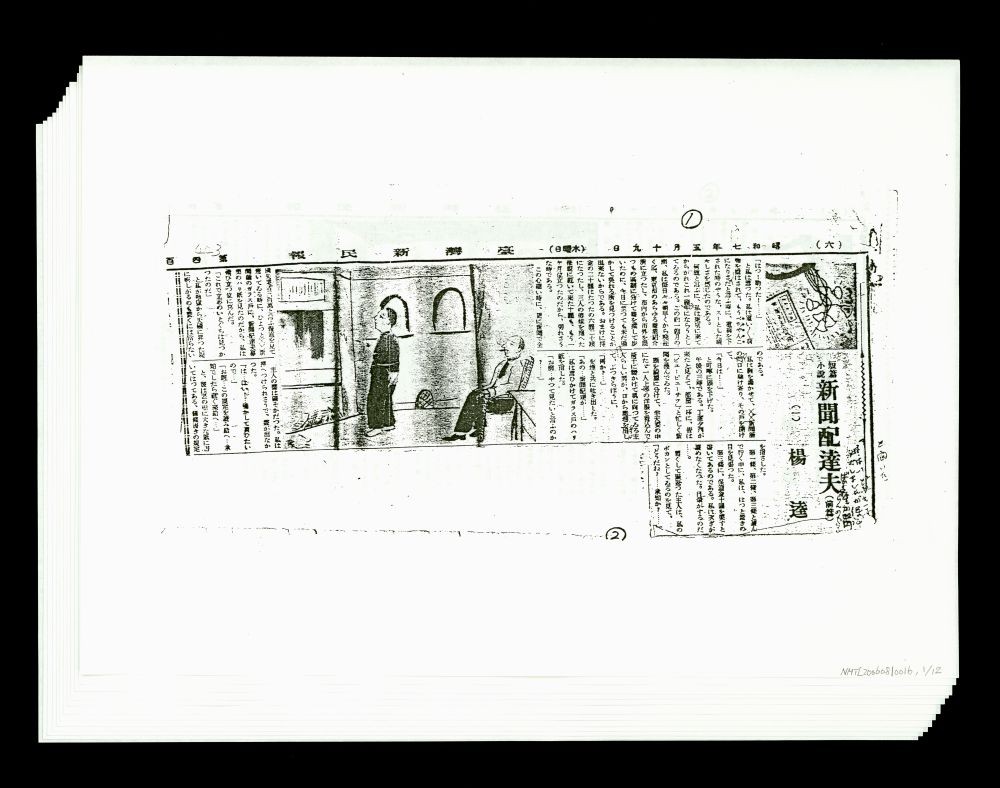
Yang Kuei "Shimbun Haitatsu Fu" (Part I) Newspaper Clipping (Photocopy), 1932 / Collection of The National Museum of Taiwan Literature
Serialized in 1932 in the Taiwan New People's Newspaper, "Shimbun Haitatsu Fu" was Yang Kuei’s breakthrough work. Only the first part was published, as the second part was banned. In 1924, seeking to broader his horizons, Yang Kuei went to Japan, and the following year enrolled the following year in Nihon University’s Department of Literature and Arts (night school). By day, he worked as a newspaper carrier, plasterer, and odd laborer to pay his tuition. Through these experiences and contact with Japanese social activists, he began engaging in movements for the disadvantaged. These experiences became the foundation for Shimbun Haitatsu Fu. Readers can also gain a deeper understanding of the novel’s settings through the accompanying illustrations, which highlight the perseverance and courage of people resisting dark forces at that time.
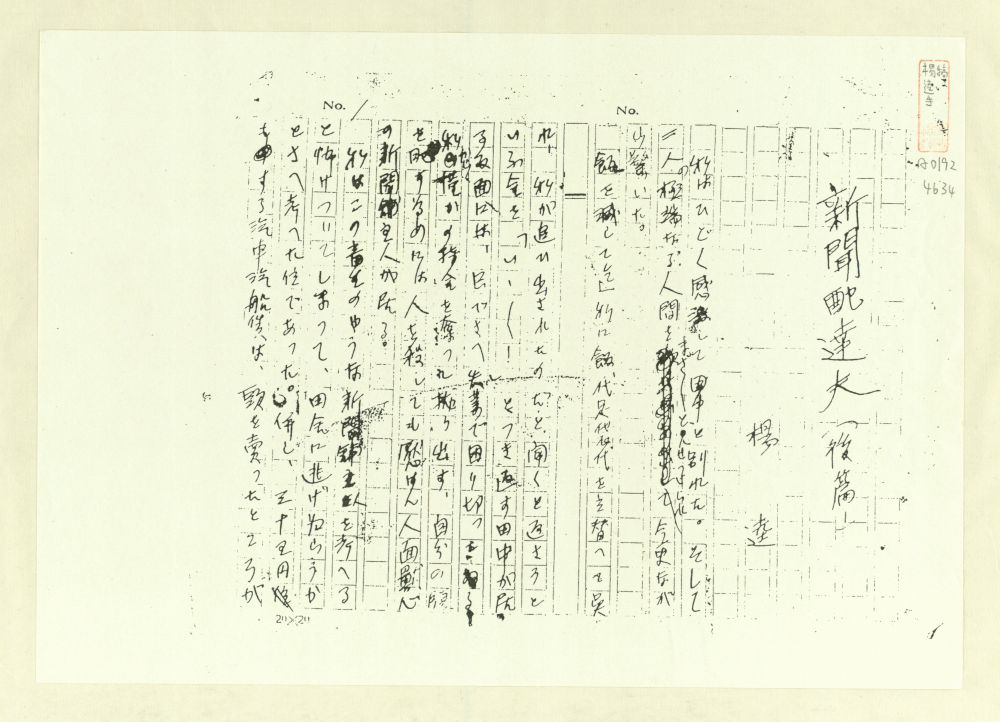
Yang Kuei Shimbun Haitatsu Fu (Part II) Manuscript (Photocopy), 1934 / Collection of The National Museum of Taiwan Literature
The story describes how the protagonist, Yang Chun, after being expelled from a newspaper office by its owner, sits in a park reflecting on his family’s plight in Taiwan.Once prosperous landowners, his family lost their farmland under police coercion to a sugar factory at unfair prices, plunging them into poverty. He realizes that both Tokyo and Taiwan suffered under oppression and hardship. Through his Japanese friend Ito, Yang Chun learns methods of resistance and decides to bring them back to Taiwan. A Chinese translation can be found in Volume 4 of the Complete Works of Yang Kuei.
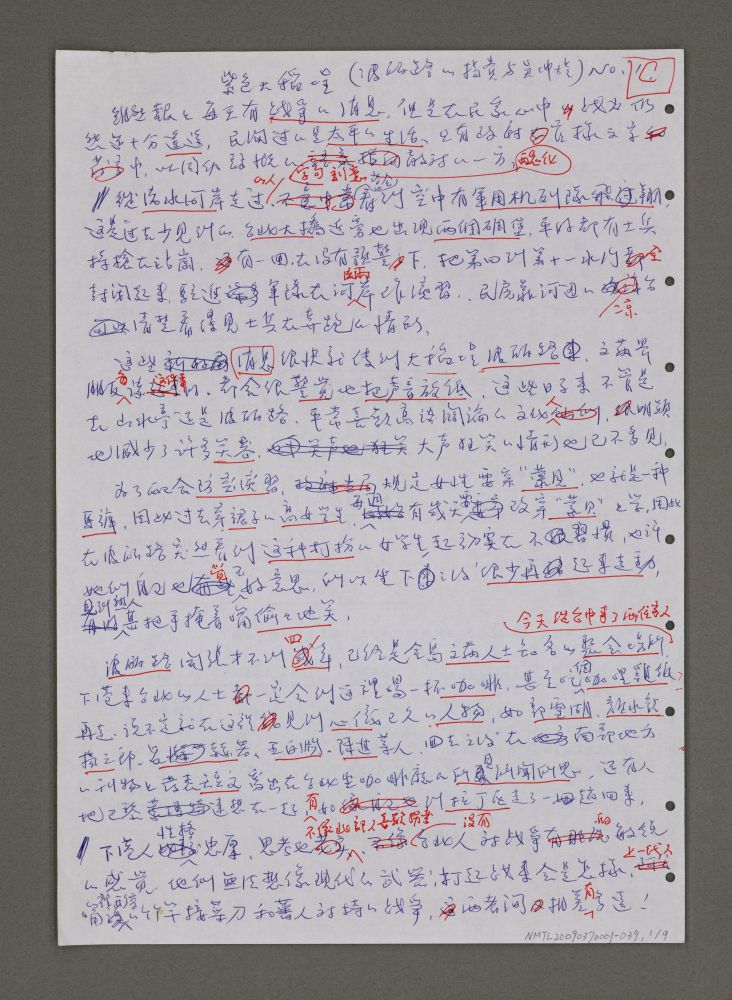
Hsieh Li-fa La Grande Chaumière Violette Manuscript, Date Unknown / Collection of The National Museum of Taiwan Literature
This historical novel portrays the lives of the first generation of Taiwanese artists growing up under Japanese rule. This excerpt depicts a scene set in the Bolero café in Taipei.
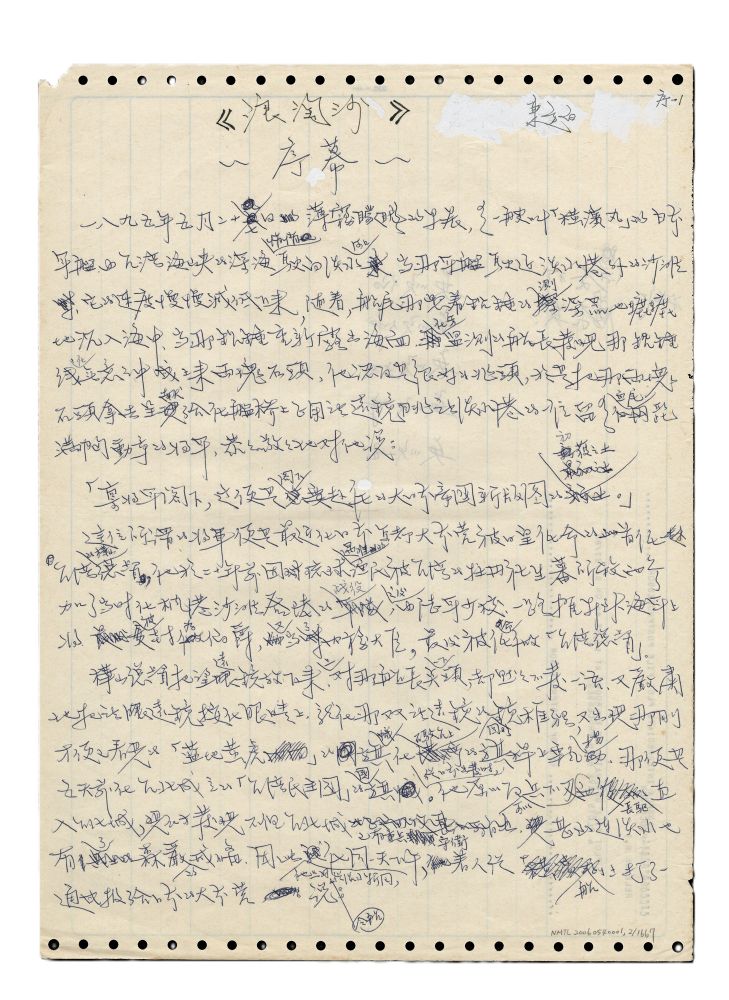
Tong Fang-Po Sand in the Waves Manuscript, 1979 - 1989 / Collection of The National Museum of Taiwan Literature
The story spans a century from the Japanese invasion of Taiwan in 1895 to modern era, ranging across East and Southeast Asia. Through the life of Taiwan’s first female doctor, Tsai A-hsin, it portrays the joys and sorrows of three families, reflecting how external forces (the waves) continually wash over the Taiwanese people (the sand), embodying the resilience of the Taiwanese spirit.
 The Figure of a Writer
Many writers’ lives are as compelling as their works. Biographical adaptations became a theme, such as PTS Taiwan’s April Rhapsody and Hakka TV’s Taipei Singer, depicting Lu Ho-jo and the zeitgeist through a play-within-a-play approach.
In 1994, Spring Entertainment produced the “Figure of a Writer” documentary series, spanning two seasons with 26 episodes. The first season focused on May Fourth writers like Lu Xun, Yu Da-Fu, and Hsu Chih-mo; the second season covered 13 Taiwanese writers including Lai Ho, Yang Kuei, Lu Ho-jo, Lung Ying-tsung, Wu Cho-liu, Chung Li-ho, Yeh Shih-tao, Chung Chao-cheng, Pai Hsien-yung, Li Chiao, Tzeng Ching-wen, Wang Chen-ho, and Wang Wen-hsing, using concise “introductory” methods to preserve precious footage and outline generational literary development.
Contemporary literary documentaries employ increasingly diverse narrative techniques and multimedia to convey both the abstract inner worlds of writers and the essence of their works, with the films themselves functioning as complete works of art. Examples include Huang Ming-chuan’s Sound of Sakura, which tells the story of Huang Ling-zhi, a writer who spent her life creating in Japanese; Huang Ya-li’s Le Moulin, released in 2016, adapted from the works and lives of members of the 1930s surrealist “Le Moulin Poetry Society”; and Hsu Hui-lin’s Yeh Shih-tao, released in 2022, which employs extensive media collage to depict both the writings and life of the author Yeh Shih-tao.
Since 2011, Fisfisa Media has been producing the documentary series The Inspired Island, with each episode directed by a different director. The first season profiled Lin Hai-yin, Chou Meng-tieh, Cheng Chou-yu, Yu Kwang-chung, Wang Wen-hsing, and Yang Mu; the second season, released in 2015, featured Lo Fu, Ya Hsien, Lin Wen-yueh, Pai Hsien-yung, Xixi, Yesi, and Liu I-chang; and the third season, released in 2021, documented the literary works of the Chu family writers - Chu Hsi-ning, Liu Mu-sha, Chu Tien-wen, and Chu Tien-hsin - alongside Chi Teng Sheng, Wu Sheng, and Yang Ze. The Inspired Island closely engages with the inner lives of these writers, delving into their daily routines, and has received widespread acclaim from literary enthusiasts.
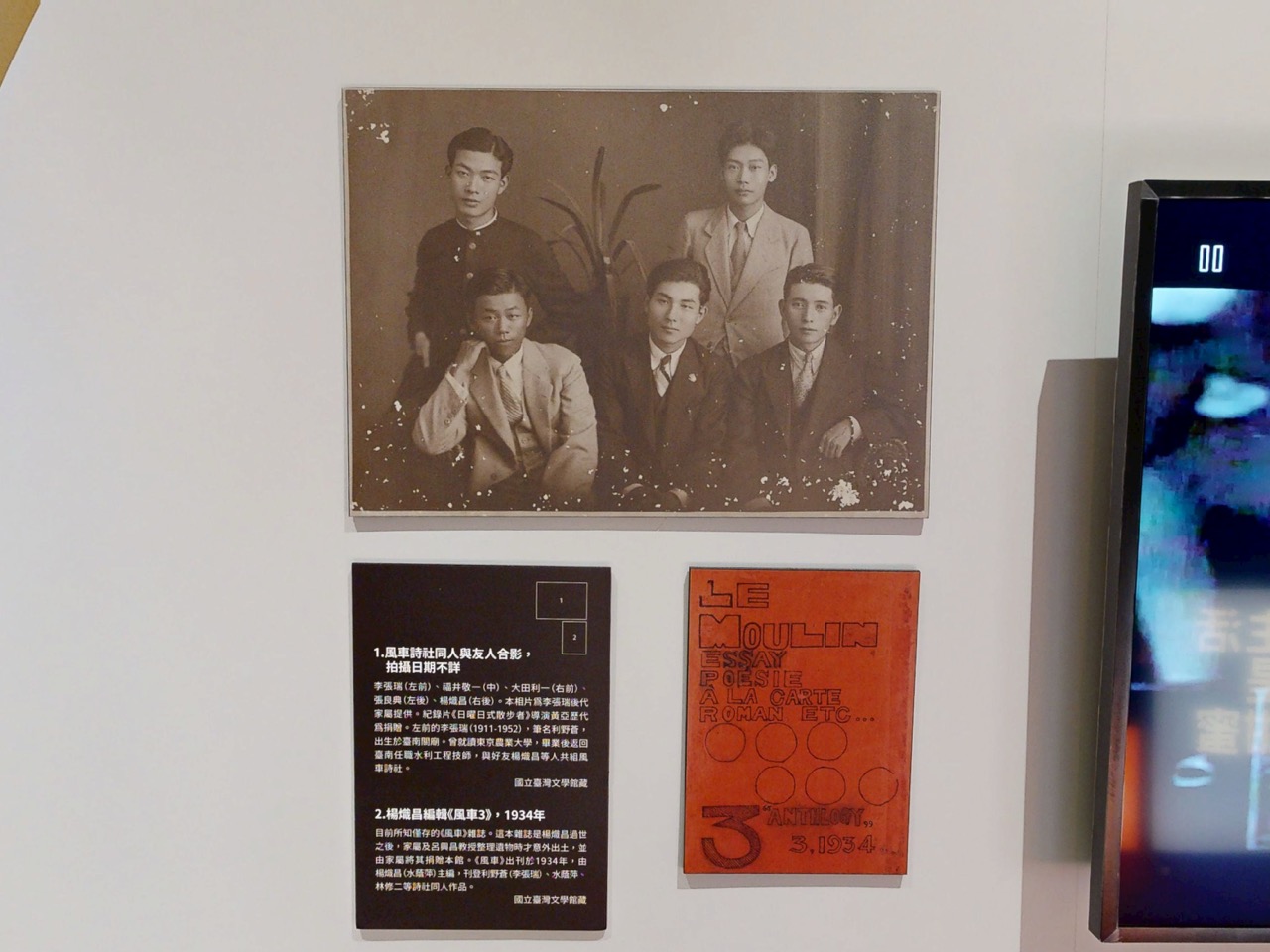
Le Moulin Poetry Society Members and Friends Group Photo, Date Unknown / Collection of The National Museum of Taiwan Literature
From left to right: Li Chang-jui (front left), Keiichi Fukui (center), Riichi Daiden (front right), Chang Liang-tien (back left), Yang Chi-chang (back right). This photo was provided by Li Chang-jui’s descendants and donated by director Huang Ya-li of the documentary Le Moulin. Li Chang-jui (1911 - 1952), pen name Rino Aoi, was born in Guanmiao, Tainan. After studying at Tokyo University of Agriculture, he returned to Tainan as a hydraulic engineer and co-founded the Le Moulin Poetry Society with Yang Chi-chang and others.
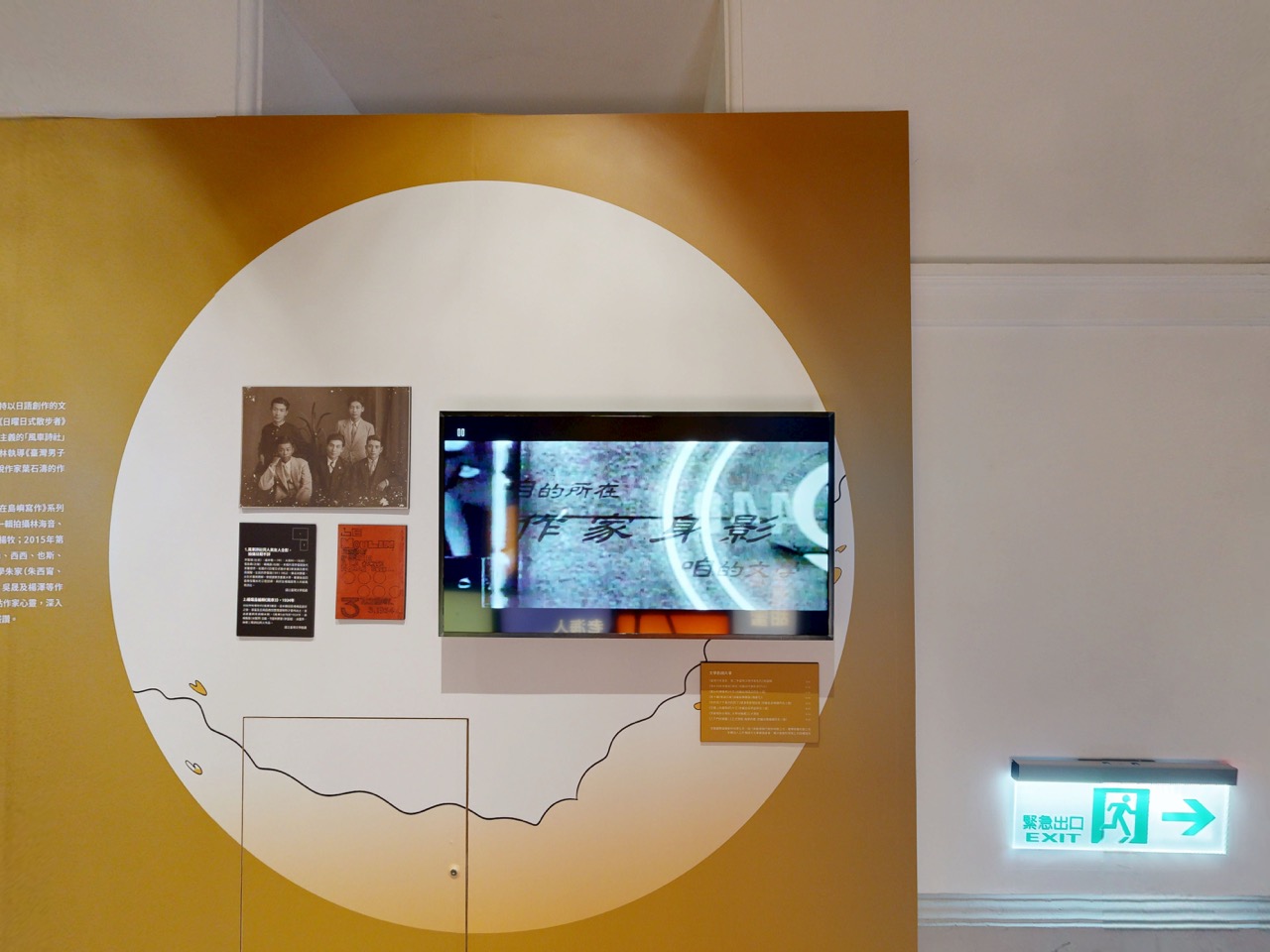
(Taiwanese Writers: Season 2) Highlights 20:00
The Leaking Bookstore trailer (adapted from Wolf Hsu’s FIX) 1:00
I Am the Secret in Your Heart excerpt (adapted from Margie Doe’s novel of the same name) 1:49
Seqalu: Formosa 1867 behind-the-scenes (adapted from Chen Yao-chang’s Lady The Butterfly) 3:40
On Children interview with director Chen Hui-ling (adapted from Wu Hsiao-le’s novel of the same name) 2:00
The Magician on the Skywalk excerpt (adapted from Wu Ming-yi’s novel of the same name) 6:00
Qseries Preview_Literature Adaptations official trailer 1:00
Port of Lies official trailer - The Coastal Murder Case (adapted from Tang Fu-jui’s novel of the same name) 1:30

1. Privacy protection policy.
Personal privacy has become the main concern of users when browsing in the online world. The National Museum of Taiwan Literature (hereinafter referred to as the museum) has specially created a privacy protection policy. How to collect and use data", "Cookies, IP address", and "Protection and Use of Personal Data" to explain and declare:
(1) How to collect and use personal data:
In order to provide you with the best on this website The website service, according to different pages, will ask you to provide relevant personal information. The scope is as follows: This website is when you use the system function forms such as e-newslet subscription, group tour reservation, event registration, joining literary friends and publishing seminar information , Will retain the name, email address, contact method and usage time you provided.
(2) Cookies and IP Address:
When a user visits this website, the server will record relevant behaviors by itself, including the IP address of the connected device, time of use, browser used, browsing and click data records Etc., as a reference for us to improve our website services, this record is an internal application and will never be published.
(3) Protection and utilization of personal data:
The hosts of this website are equipped with various information security equipment such as firewalls, anti-virus systems and necessary safety protection measures to protect the website and your personal data. We adopt strict protection measures. Only authorized personnel can access your personal data. The relevant processing personnel have signed confidentiality contracts. Anyone who violates confidentiality will be punished by relevant laws.
Although this website will do its utmost to maintain the user’s personal data (not misused or disclosed), because the transmission of network data cannot ensure 100% security, this website cannot be sure or guarantee that the user’s or The data we send to users is completely secure. Regarding the above risks, users must be asked to bear them.
Unless you obtain your consent or other special provisions of laws and regulations, this website will never expose your personal data to a third party or use it for other purposes than the collection purpose.
2. Information Security Policy
The National Museum of Taiwan Literature (hereinafter referred to as the museum) respects and protects your security and privacy protection while using the Internet, in order to help you understand how the "National Museum of Taiwan Literature Global Information Network" protects your use of various services on this website For security, and how to collect, apply and protect the personal information you provide, please read the privacy protection and security policy of the "National Taiwan Literature Museum Global Information Network". Please read the following instructions carefully. You are also welcome to tell us your thoughts. If you have any comments or questions, please E-mail to twp@nmtl.gov.tw for
any unauthorized attempts to upload or modify the information provided by the library All services and related information activities are strictly prohibited and may violate the law. For site security purposes and to ensure that the service will continue to serve all Internet users, this site provides the following security measures:
. Use a network intrusion detection system to monitor network traffic to identify unauthorized attempts to upload or change, web page information, or sabotage.
. Install a firewall to prevent illegal intrusion, destruction, or theft or destruction of data, to avoid illegal use of the website, and to protect the rights of users.
. Install anti-virus software to scan for viruses regularly to provide users with a safer web browsing environment.
. Simulate hacker attacks from time to time, exercise system response procedures when security incidents occur, and provide appropriate security defense levels.