訊息
OK
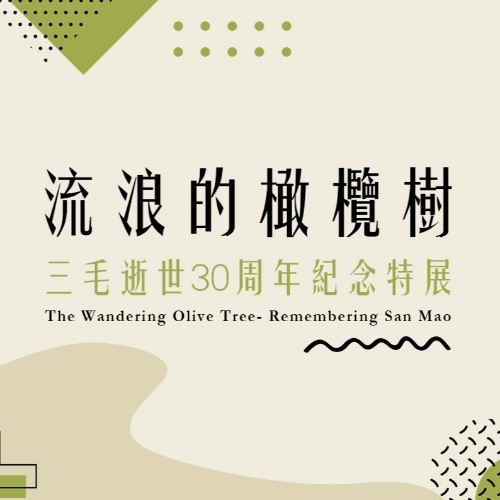
The Wandering Olive Tree - Remembering San Mao
0
加入收藏
Introduction
Area
Introduction
“Don’t ask me where I’m from…” Do you recall the lyrics from “Olive Tree”, and the writer San Mao?
During the time when Taiwanese society was still very rigid, San Mao inspired many minds and souls who yearned for freedom with her wanderlust, foreign love stories, life in Sahara, and her prolific publication of over twenty literary works.
On 4 January 1991, San Mao ended her own life in Taipei. Her writings and cherished items were all donated to the National Museum of Taiwan Literature (NMTL). Thirty years after her passing, we come together with book-lovers of all generations to explore her free spirit and sincerity through her manuscripts and collections.
Her Life: A Name Synonymous With Nonconformity
San Mao was born Chen Mao-ping in 1943. She changed her name into Chen Ping later when she grew up, for she thought that character had too many strokes.
She didn’t like to study during junior high school but enjoyed reading. She then quit school and studied by herself from home. She liked writing and submitted works to Modern Literature magazine. She was then admitted to the Department of Philosophy at Chinese Culture University. In 1967, Chen Ping went to Spain alone and attended Madrid University. That was where she met José María Quero y Ruíz for the first time.
She returned to Taiwan to become a teacher in 1971 when her love life didn’t go well. Two years later, she returned to Spain and once again crossed path with Jose, who had then become a diver. It had been six years since they first met and they decided to go to Spanish Sahara together. They got married in 1974. In October of that year, she wrote about her life in Sahara under the title “Chinese Restaurant” and submitted it to the literary supplement of United Daily News under her penname San Mao.
Her Works: Taiwan’s Most Spectacular Travel Writing
The prose style of “Chinese Restaurant” was so uncommon to the readers in Taiwan and propelled the San Mao frenzy. She described how the desert people took a bath every four years and used water pipes to clean the inside of their bodies. Whether writing about unimaginable characters or romantic stories, San Mao wrote from a first-person point of view. They sounded like exaggeration or fictional, but her stories were real.
San Mao often wrote about the unique romance between herself and Jose. They once bought a car and nicknamed it ""white horse"", which was mentioned several times in her works. The license plate of the car, ""SH-A3480"" was also part of the donated collection, which inspired the NMTL to make a creative product-a sun-blocking umbrella. Following her 1976 essay collection titled “The Stories of the Sahara”, she then published “The Scarecrow’s Journal”, “The Crying Camel” and “The Tender Night”, which all became best-sellers. Even as of today, San Mao can be said to be the most influential and popular literati in Taiwan.
Her Era: The Spirit of Risk-taking for Freedom
In the sixth year of their marriage in 1979, Jose died in a diving accident. It was devastating and she quietly returned to Taipei and continued writing and traveling. In 1981, under the sponsorship of the United Daily News, she traveled to Central and South America and wrote “I Have Walked Thousands of Miles”. This marked the end of the San Mao Frenzy in Taiwan that lasted for 15 years.
The wanderings of San Mao in the desert and her foreign love stories opened new windows for the people of Taiwan to see the world beyond the confines of their homeland during those conservative times. San Mao occasionally was criticized for being a hypocrite or for not being truthful, but she firmly insisted that all her words are genuine. Authentic or imaginative, San Mao allowed people to understand that liberty and freedom is something that one must take a risk to fight for.
“My heart is filled with joy as I welcome this brand new year of 1991,” wrote San Mao in the opening of her final work, “It’s Also Nice to Dance a Song"", which was completed at the end of 1990. She committed suicide at a hospital on 4 January 1991 and ender her legendary life at the age of 48."